


Most companies do not truly own their website. They own a login. The strategy, the code, the data, and often the intellectual property sit with a third-party agency or platform that they pay every month just to keep the lights on. AI-accelerated web design and development breaks that dependency. For the first time, a smart, modern, high-performing website can be planned, built, and handed over to you completely, with no ongoing hostage fees and no mystery code you cannot touch.
TL;DR: Third-party web providers have long kept companies dependent and in the dark. AI now makes it practical to build faster, smarter, and fully owned websites. Tools like Claude Code and OpenAI Codex put serious capability in the hands of our designers and developers, compressing timelines and costs without sacrificing craft. The key is pairing those tools with a producer-led team that starts with your strategy, not a template.
The Problem With How Most Websites Get Built
The traditional web development model was built around scarcity. Design was slow and expensive. Development required specialists. Updates meant submitting a ticket and waiting. So companies signed contracts with agencies or jumped onto platforms that promised simplicity, and in exchange they quietly gave up control.
Here is what that looks like in practice. Your website lives on someone else's infrastructure. The analytics feed into a dashboard only they can fully interpret. Making a copy change requires approval or a billing event. And if you ever want to leave, the migration is painful enough that most companies just stay.
That model made sense when building a quality website took months and a large team. It does not make sense anymore.
What AI Actually Changes About Web Design and Development
AI does not replace the thinking that makes a website work. It accelerates the production of everything that surrounds that thinking. Wireframes that used to take days can be roughed out in hours. Copy frameworks, layout options, SEO structures, image treatments, and responsive behavior can all be iterated faster than any traditional workflow allows.
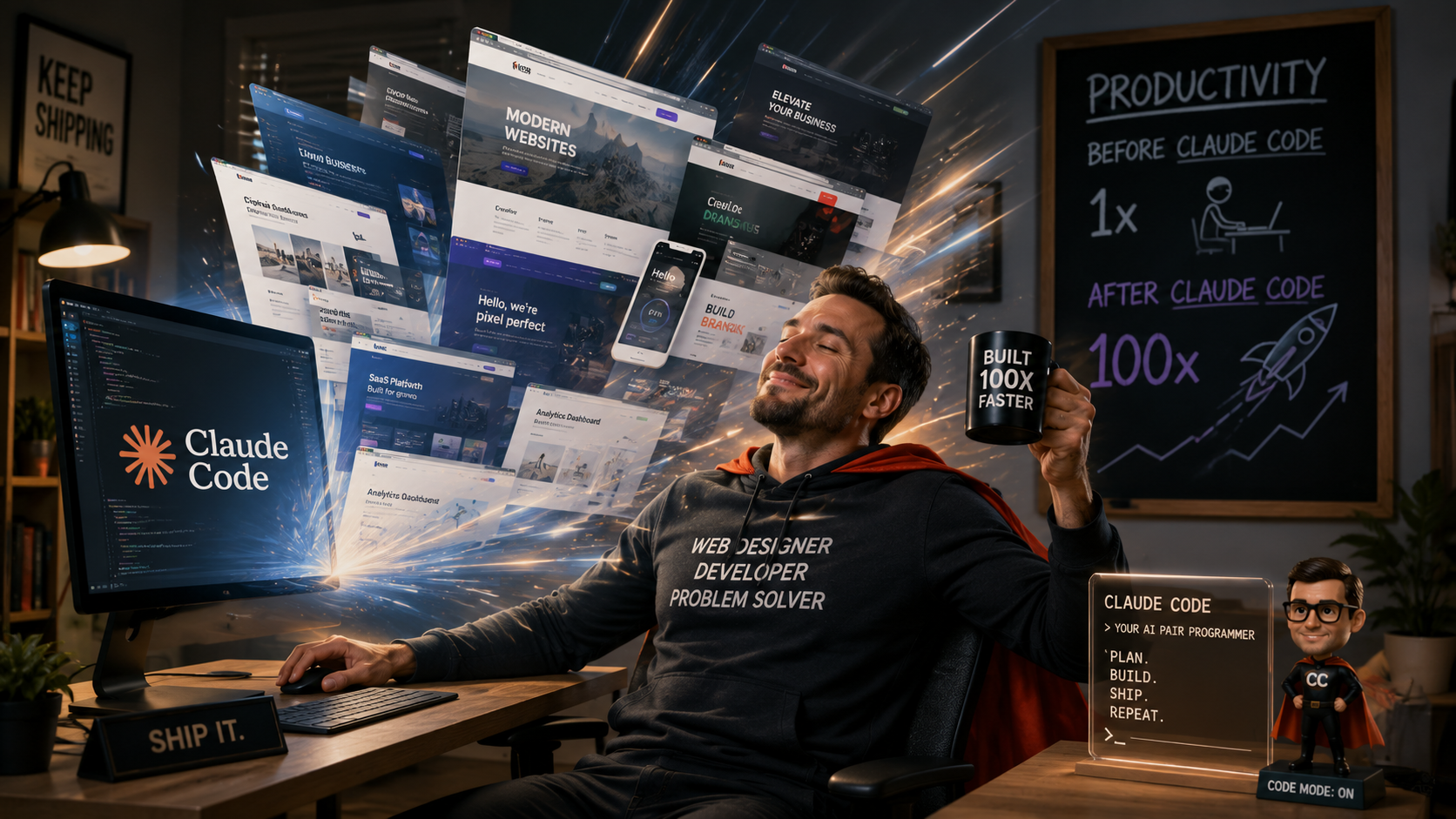
Powerful tools are driving that speed. Claude Code helps our developers write, review, and refine code at a pace that was simply not possible before. OpenAI Codex brings similar capability to custom logic and functionality. Together with other AI-assisted design and development tools, they let our team tackle complex, bespoke builds in a fraction of the time and at a fraction of the cost that traditional development shops would charge. Your custom needs do not require a massive budget or a six-month runway.
That speed shift is significant, but it is not the most important change. The more important change is strategic. When production time compresses, the team can spend more time on what actually drives results: understanding your audience, mapping the user journey, clarifying your message, and building something that converts.
AI also makes it practical to build on open, portable foundations. Your site can be architected so that you own the code outright, the analytics belong to you, and no single vendor holds the key.
Rethinking Your Web Presence From the Ground Up
Most companies redesign a website by asking, "How do we make what we have look better?" That is the wrong starting question. The right question is, "What should our website actually do for our business, and does our current presence do any of that?"
A producer-led approach starts there. Before a single pixel is placed, the strategy conversation covers who is arriving at your site, what they need to understand, what action you want them to take, and how you will know if it is working. That conversation shapes everything, from the architecture down to the button copy.
This is where a full-service studio is different from a web shop. We are not executing a design brief. We are helping you think through the outcome first, then building the tool that delivers it.
The Ownership Advantage
When Mainstage builds a website, the client owns it outright. The code, the content, the analytics dashboards, the domain logic. There is no platform lock-in and no monthly fee owed to us just to keep the site running. That is a deliberate choice, not a side effect of how we work.
Ownership changes how you think about your site. When the asset is yours, you invest in it differently. You update it. You test things. You connect it to your broader marketing stack on your own terms. You treat it like the business tool it is, instead of the utility bill it has been.
Custom analytics dashboards, built specifically around the metrics your team actually tracks, are part of that picture. Not a third-party report that someone else interprets for you. A live view of your own data, in plain language, that your team can act on.
AI Plus Human Craft: Why Both Matter
AI can generate fast. It cannot generate right without a human shaping the input, reviewing the output, and making judgment calls that require real-world context. The production teams that get the best results from AI are the ones that treat it as a capable collaborator, not an autopilot.
At Mainstage, tools like Claude Code and OpenAI Codex accelerate the work. David Pichette and the team direct it. Every page, every flow, every content decision still gets a human eye and a strategic lens before it goes anywhere near a client review. The speed is real. The craft is real. They are not in conflict.
That combination also means the budget that used to go toward billing hours for slow production work can go toward better strategy, stronger content, and more thorough testing. You get more of what matters, for less than you would expect to pay.
Signs It Is Time to Rethink Your Web Presence
- You are not sure who owns your site's code or where it lives.
- Making a simple update requires contacting someone outside your company.
- Your analytics come from a dashboard you did not set up and cannot fully read.
- Your site looks like it was built for a different version of your company.
- You are paying a monthly retainer but cannot point to what it produces.
- Your site does not reflect how you actually talk about your brand today.
Any one of those is worth a conversation. All of them together is a clear signal that a rebuild, done the right way, will pay for itself.
What a Full-Service Web Engagement Looks Like
A Mainstage web engagement starts with a strategy session, not a proposal deck full of templates. We learn the business, map the audience, and agree on the outcomes the site needs to drive. From there, we move through architecture, design, content, development, and launch as one continuous team, not a relay race between vendors.
AI tools like Claude Code and OpenAI Codex are running in the background throughout, letting our designers and developers move faster on your custom requirements without cutting corners. You benefit from that efficiency directly, in shorter timelines, lower costs, and a final product that is built specifically for your business.
You are involved at the right moments, reviewing real decisions, not rubber-stamping executions. And when we hand the site over, we walk your team through it so you can manage it confidently from day one.
The result is a finished solution, not a project file dropped in a folder.
If your current website feels like something that happened to your company rather than something your company built with intention, it is worth a conversation. Learn more about our AI-accelerated web design and development work, or reach out to book a strategy call with David and the team. We will start with your goals, not our portfolio.