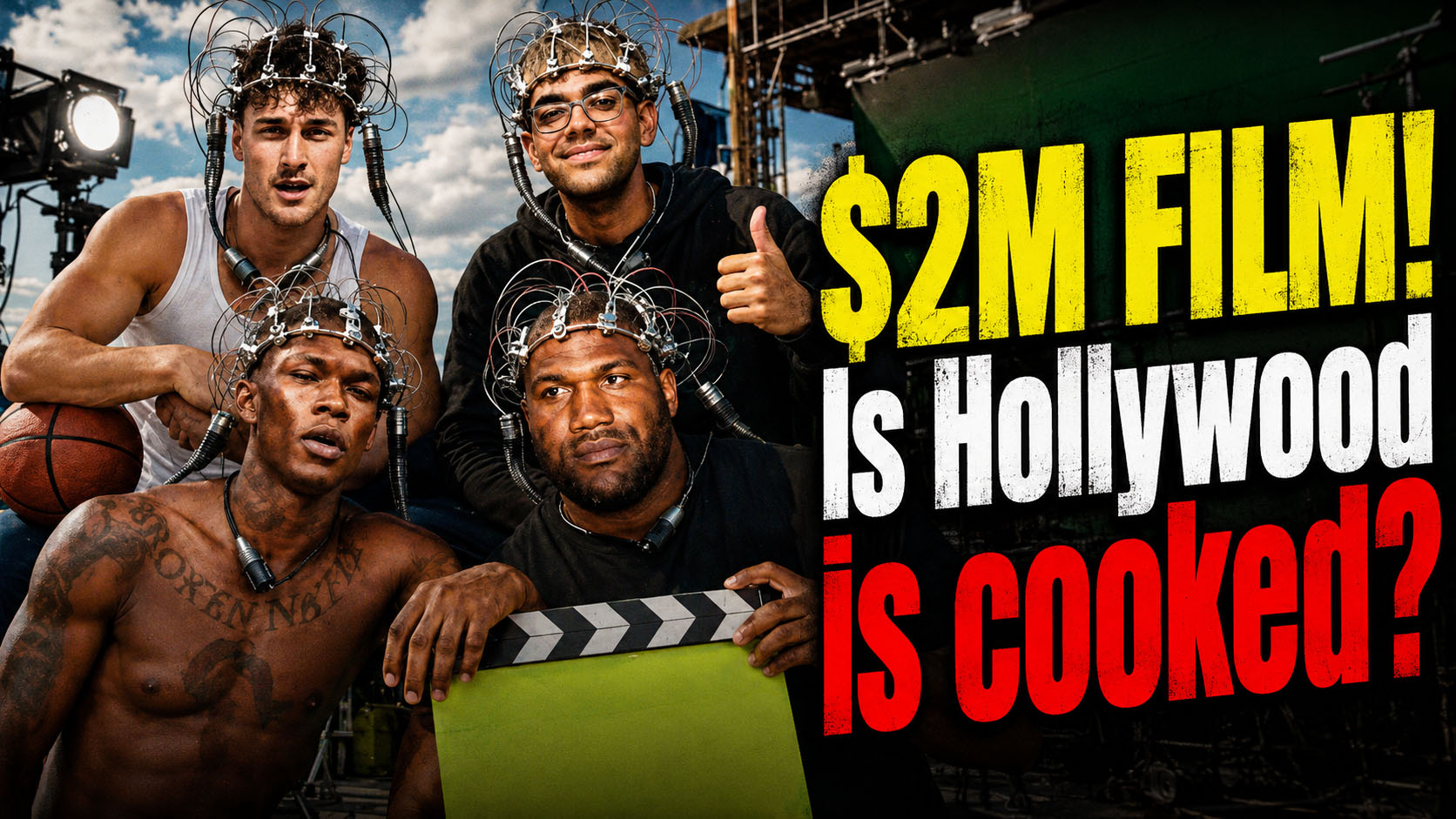




AI is not replacing great editors. It is eliminating the busywork that keeps them from doing great work. That is the distinction MrBeast drew on the PowerfulJRE podcast, and it is the most honest framing of AI in post-production we have heard from anyone working at serious scale. For brands and marketing leaders hiring a production partner, that distinction matters enormously.
What MrBeast Actually Said
In this episode of the PowerfulJRE podcast, MrBeast was precise about how his team uses AI tools in post-production. The point was not automation for its own sake. It was about identifying the tasks that drain an editor's time and attention without adding creative value, and using AI to handle those instead. The editors stay. The craft stays. What goes away is the grind that was never the job in the first place.
That framing is worth sitting with. A lot of the conversation around AI in video production goes to one of two extremes: either AI is going to replace everyone, or it is a gimmick that serious creatives ignore. MrBeast's view is neither. It is practical and outcome-focused, which is exactly how good producers think.
The Scale He Is Actually Talking About
To understand why MrBeast's AI philosophy matters, you have to understand the scale at which he is operating. Beast Games, his Amazon Prime competition series, was not a standard production. It was described during the podcast as the biggest show ever made, and the numbers behind it make that claim believable.
The production set records for the most cameras and cabling ever used on a single shoot. That cabling alone ran 27 miles. The casting process drew in more contestants than any competition format before it. The editing team required to process that volume of footage was enormous, working across material that would have been physically unmanageable without systematic tools to organize and surface usable takes.
That context is essential. When MrBeast talks about using AI to eliminate busywork, he is not describing a streamlining trick for a modest YouTube video. He is describing a production necessity at a scale where even well-staffed human teams would be buried without intelligent systems handling the mechanical layer. The signal-to-noise problem when that many cameras are rolling simultaneously is not something you solve by hiring more editors. You solve it by building smarter infrastructure around them, so their time goes to decisions, not to data management.
For most brands, the production scale is nowhere near Beast Games. But the underlying principle is identical: the more footage, complexity, and moving parts you have, the more AI earns its place as infrastructure rather than novelty.
The Busywork He Is Talking About
To apply this idea usefully, it helps to be specific about what "busywork" actually means in a post-production context. Here are the categories where AI genuinely earns its place:
- Transcription and rough assembly. Turning hours of footage into a searchable transcript and pulling selects used to take a full day. AI does it in minutes, accurately.
- Noise reduction and audio cleanup. Leveling dialogue, removing background hum, and matching room tone across clips are time-consuming and largely mechanical. AI handles them well.
- Rough cut organization. Sorting, tagging, and grouping footage by content or scene type is clerical work. AI accelerates it without judgment calls.
- First-pass color correction. Getting footage to a neutral, consistent baseline before a colorist makes creative decisions is a repeatable task. AI can do that lift.
- Caption generation. Accurate captions in multiple formats, ready for review and correction, in a fraction of the time.
None of these tasks require storytelling instinct. All of them eat hours. Removing them does not make the product less human. It makes the humans more available for the work only they can do.
What AI Cannot and Should Not Touch
The tasks AI eliminates are valuable precisely because of what they free up. The following are not tasks. They are the job:
- Deciding which moment in an interview lands and which one undercuts the message.
- Choosing the cut that creates tension versus the cut that releases it.
- Knowing when a brand's tone requires restraint and when it requires energy.
- Shaping a narrative arc that actually moves an audience toward a decision or feeling.
- Reading the client's goals and translating them into visual and editorial choices.
These are producer and director decisions. They require context, taste, and accountability. No AI tool has any of those things. The moment a production partner claims otherwise, ask them to explain the last three creative decisions they made and why.
Why This Matters If You Are Hiring a Production Partner
If you are a marketing director, a learning and development manager, or a founder commissioning video content, the MrBeast framing gives you a useful filter for evaluating production partners.
A team that uses AI well will deliver faster without cutting corners on creative quality. They will have more senior time available for strategy, story, and refinement because junior-level mechanical tasks are handled efficiently. Turnaround shrinks. Revision cycles tighten. The finished product reflects more human judgment, not less, because that judgment was not burned up on transcription and rough assembly.
A team that ignores AI entirely may be leaving meaningful time and cost savings on the table, and passing that inefficiency to you. A team that leans on AI as a replacement for editorial skill will deliver content that feels flat and generic, because no one with taste was actually driving it.
The right partner uses AI the way MrBeast described: as infrastructure, not as a creative director.
How We Work at Mainstage Multimedia
At Mainstage Multimedia, AI tools are part of our production workflow at every stage where speed and accuracy are the point. Transcripts, selects, audio cleanup, caption drafts, rough organization: we use AI to move through those quickly so our producers and editors can spend their time on what actually shapes the final product.
That means more strategic pre-production conversation. More editorial precision in the cut. More time spent on the details that make a brand film feel intentional rather than assembled. And faster delivery without the bottlenecks that inflate timelines and frustrate clients.
We are a producer-led studio. David Pichette and our team take responsibility for the finished work, start to finish. AI is a tool in that process. It is not the process.
If you want to see what that looks like on a project, we are happy to walk you through how we plan, produce, and deliver. Explore our video production work or reach out to book a call. We will start with your goals, not our gear list.