



A Full-Length Feature Film for $2 Million in Four Weeks. Hollywood Is Not Ready for This.
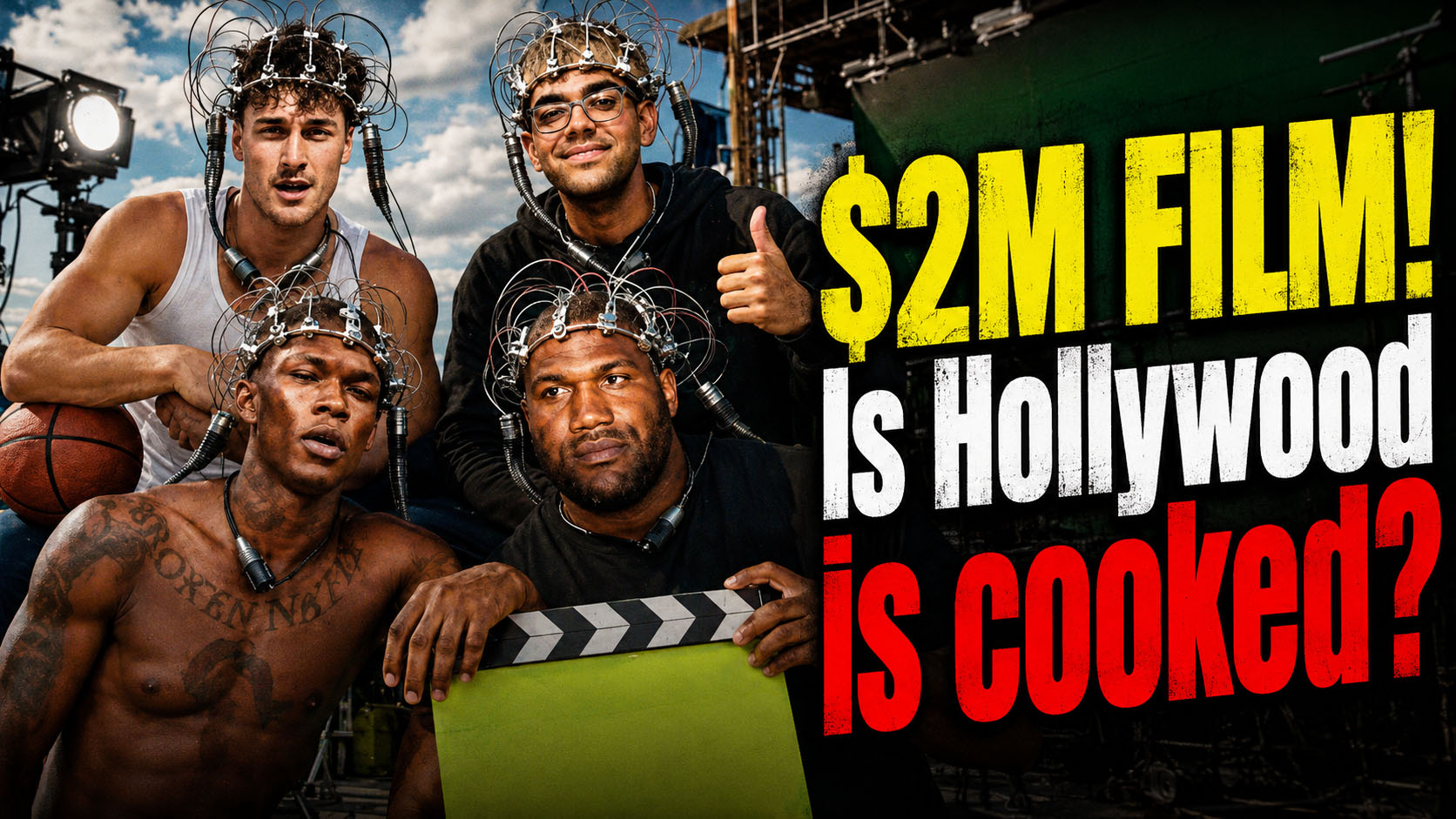
A film crew of 28 people. Four weeks on the clock. Two million dollars out the door. And a 110-minute feature film at the end of it.
That is what Higgsfield AI demonstrated with Cully Hill Boys, and the production and marketing world is still catching up to what it means. The Verge covered the production in detail, and the story was also discussed on Peter Diamandis's Moonshots podcast alongside a panel that included investor Dave Blondon, futurist Salim Ismail, and AI founder Emad Mostaque.
Neither the press nor the panel framed this as a curiosity. They framed it as a structural shift in the economics of video production. So do we.
TL;DR: Higgsfield just produced a 110-minute feature film using AI video generation tools, 28 people, four weeks, and roughly $2 million. A comparable Hollywood production would cost $20 to $100 million and take 12 to 18 months. This is not a demo. It is a finished film that landed on the Black List, Hollywood's annual survey of the most-liked unproduced screenplays and produced projects. Here is what that means for anyone who commissions video content for a living.
What Higgsfield Actually Did
Higgsfield did not just make a cheap film. They built and published a repeatable workflow covering their entire production process, then used that workflow to execute a feature-length production at a fraction of traditional cost. The finished film earned a Black List placement, a signal that the industry is paying serious attention to both the project and the method behind it.
The numbers tell the story quickly. Consider a traditional Hollywood production of comparable scope:
- Budget range: $20 million to $100 million
- Timeline: 12 to 18 months minimum
- Crew size: hundreds of people across departments
Now consider what Higgsfield delivered:
- Budget: approximately $2 million
- Timeline: four weeks
- Crew: 28 people
That is roughly 2 percent of the cost and 6 percent of the time. Those are not rounding errors. That is a category change.
How They Did It: The Tools Behind the Production
The Diamandis panel broke down the underlying technology stack making this possible. A few specifics worth knowing if you produce or commission video content at any scale.
LTX 2.5 is currently the leading open-source text-to-video model. It runs on a MacBook Pro. It generates a 10-second broadcast-quality clip in approximately 7 seconds. That is not a render farm. That is a laptop on a desk.
Compute costs for AI-generated video are collapsing. At the time of the podcast recording, generating 30 seconds of high-quality AI video cost roughly $3. A full feature film at current Hollywood-equivalent quality runs approximately $100,000 in compute costs. The panel projected that number will drop to around $10,000 in the near term.
Higgsfield also published their production methodology openly. The panel noted that publishing the process, not just the finished product, drove significant earned attention and contributed to building a revenue run rate reported at $700 million in roughly 18 months. Transparency about method turned out to be a serious business strategy, not just a generous gesture.
Why a Producer Still Matters More, Not Less
Here is where most of the industry commentary gets this wrong.
The story is not that AI replaced a film crew. The story is that a producer-led team used AI tools strategically to execute a feature film faster and cheaper than anyone thought possible a few years ago. Those 28 people still made every creative decision. The AI compressed the execution, not the thinking.
This distinction matters enormously if you commission brand films, corporate videos, training content, or campaign video at any scale.
The tools are now accessible to almost anyone. LTX 2.5 runs on consumer hardware. Dozens of other text-to-video models are available today. What is not accessible to everyone is the producer judgment to know which tool to use, when to use it, how to integrate AI-generated assets into a coherent branded story, and how to ensure the result actually serves a business goal rather than just looking interesting.
An AI tool does not know your brand. It does not know your audience. It does not know whether the emotional tone of a generated sequence will convert a prospect or confuse one. A producer does.
Unsophisticated teams that try to replicate the Higgsfield result without that layer of strategic judgment will produce generic, incoherent content at low cost. That is a real risk, and we are already seeing early examples of it in the market.
What This Means for Your Video Budget Conversation
If you are a marketing or brand leader who has been working with a traditional production budget, this development changes the conversation you should be having with your production partner.
The question is no longer how do we afford a brand film. The question is what volume and variety of video content can we produce at this budget level now that the cost floor has dropped.
A client who previously budgeted $150,000 for a single flagship brand film over eight weeks now has real options. That same budget, applied through a hybrid AI-assisted production workflow led by a producer with a clear content strategy, can yield a brand film plus a library of campaign assets, episodic content, or training modules. The output multiplies. The strategy still has to be right, or none of it performs.
At Mainstage, we are actively integrating AI video generation into our production workflow because our clients deserve the efficiency gains these tools make possible. We are not using AI to cut corners. We are using it to do more with the same investment, faster, without sacrificing the creative direction and strategic thinking that makes content actually work. Our full-service production approach means you get the finished solution, not a pile of AI outputs to figure out on your own.
The Wider Industry Signal
The Diamandis panel noted one other detail worth flagging for anyone in media or production.
Nine of the top ten text-to-video AI models on international leaderboards are currently coming from Chinese labs. These models are not just training on aesthetic quality. They are training on physics, motion, object permanence, and causality, the same underlying capabilities needed for robotics and autonomous systems. The panel's view is that consumer video generation and enterprise AI reasoning will converge within a very short window.
That convergence has significant implications for anyone who creates video content professionally. The production tools of the near future will not just generate attractive imagery. They will reason about narrative structure, pacing, and audience response in ways that today's tools cannot yet do reliably. The producers and studios that are building fluency with current-generation AI tools now will be the ones positioned to direct those more capable systems when they arrive.
The Bottom Line for Anyone Who Commissions Content
Higgsfield's Cully Hill Boys is a proof of concept with real commercial implications. A Black List placement confirms this is not just a technical stunt. It demonstrates that the cost and time barriers separating ambitious video content from modest video content have collapsed faster than most of the industry expected.
The opportunity for brands, marketers, and content teams is real. So is the risk of treating AI video tools as a shortcut rather than as a capability to be directed by experienced producers with a clear strategic brief.
If you want to understand what a hybrid AI-assisted production workflow could mean for your specific content goals, let's have that conversation. We can tell you exactly what is realistic, what is not, and what a finished result actually looks like when the process is managed by people who have been doing this for a long time.