


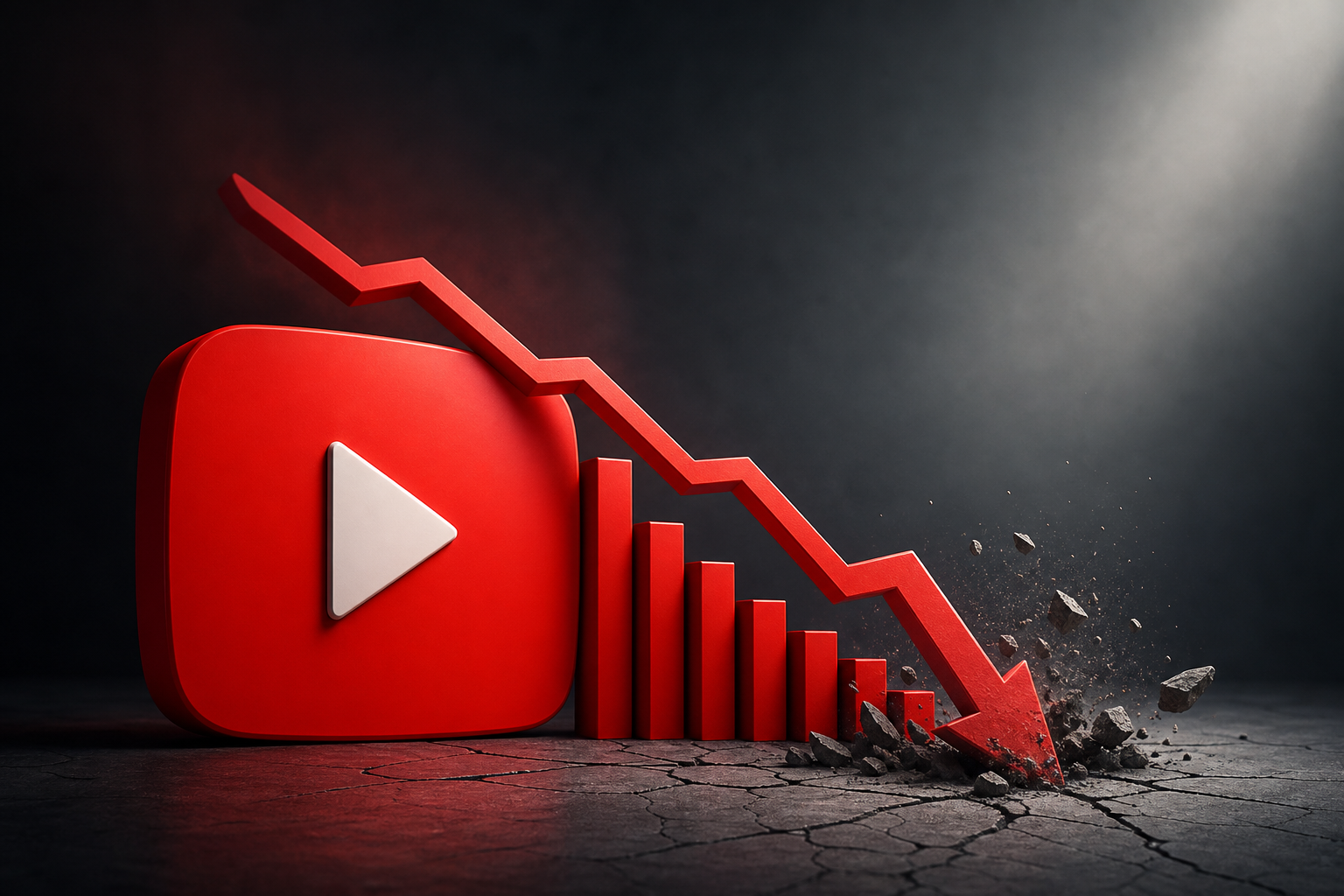
If your YouTube analytics show rising view counts but shrinking ad revenue, your content is being watched in shorter bursts than the platform wants to reward. Views measure how often someone starts your video. Ad revenue, especially from mid-roll and skippable formats, is driven by how long they stay. When those two numbers move in opposite directions, you have a watch-time problem, not a discovery problem.
TL;DR: Views are a vanity metric if watch duration is falling. YouTube's ad algorithm rewards engagement depth, not raw play counts. The fix is not better thumbnails or more upload frequency. It is producing video that earns every minute of the viewer's time from the first frame to the last.
The Metric That Actually Pays You
YouTube's monetization model is built around watch time, not views. Mid-roll ads only appear in videos over eight minutes, and they only generate meaningful revenue when viewers actually reach those timestamps. If a large share of your audience clicks away in the first ninety seconds, those mid-rolls never fire. Your CPM looks fine. Your RPM, the revenue per thousand views you actually earn, quietly collapses.
Trending data from social media analytics platforms consistently shows the same pattern: short-form content and Shorts are pulling viewers away from long-form watch sessions. People are starting more videos but finishing fewer of them. The result is a view count that climbs while total monetizable watch time shrinks.
Why Shorts Complicate the Picture
YouTube Shorts have lower RPMs than long-form content. That is not an opinion. It is how the platform's monetization is structured. When a channel leans into Shorts for discovery, views spike. When those same viewers do not migrate to long-form content, or when they do and leave quickly, the overall revenue per view drops sharply.
Shorts are useful for top-of-funnel reach. They are not a substitute for the kind of sustained engagement that pays out well. Treating them as equivalent is one of the most common and costly mistakes brands make on the platform right now.
The Engagement Depth Gap
Here is the real problem. Most branded YouTube content was never built with watch duration in mind. It was built to look impressive in a pitch deck. It leads with a logo animation. It buries the value. It paces itself like a television commercial stretched to ten minutes. Viewers feel the padding and leave.
Engagement depth means a viewer stays, rewinds, and returns. It means average view duration above fifty percent of the video's total length. It means audience retention curves that hold flat instead of dropping off a cliff at the two-minute mark. Those numbers are what the algorithm amplifies. They are also what drives real business outcomes, whether that is course completion in an e-learning context or brand recall in a commercial one.
What This Means for Branded Video and E-Learning
For brands using YouTube as a marketing channel, the watch-time problem is a production problem. It starts in scripting and structure. A video that earns attention does it by front-loading value, sustaining a clear narrative thread, and giving the viewer a reason to stay curious. That requires a producer working from a strategy, not an editor cutting footage together after the fact.
For organizations using video in e-learning and corporate training, the stakes are even higher. No ad revenue is involved, but completion rates are everything. A learner who drops out at forty percent has not learned what you needed them to learn. The same principles that drive YouTube watch time, clear structure, purposeful pacing, authentic delivery, also drive course completion. And course completion is what your L&D investment is actually buying.
At Mainstage, we approach every video project by asking one question before we touch a camera: what does this person need to feel, understand, or do differently by the time the video ends? That outcome shapes the script, the pacing, the on-screen talent direction, and the edit. It is the difference between a video people finish and one they abandon at the ninety-second mark.
The Production Decisions That Move Watch Time
These are not abstract concepts. They are specific choices made during production.
- Open with the payoff, not the setup. Tell the viewer exactly what they will get in the first fifteen seconds. Earn their commitment before you spend it.
- Cut ruthlessly in the edit. Every second that does not advance the idea or deepen the feeling is a second that erodes retention. A tight eight-minute video outperforms a padded twelve-minute one every time.
- Use pattern interrupts deliberately. A change in camera angle, a graphic, a b-roll cut. These reset attention and push viewers past potential drop-off points.
- Script for the ear, not the page. Viewers hear your content before they process it visually. Conversational, specific language holds attention. Corporate-speak loses it.
- End with direction, not just a conclusion. A strong call to action or a clear next step keeps the viewer in your ecosystem. That is good for watch time on the current video and even better for channel-level session time.
Why a Production Partner Changes the Outcome
A crew for hire delivers footage. A production partner delivers outcomes. That distinction matters enormously when the outcome you need is not a pretty video but a video people actually watch through to the end.
When Mainstage takes on a branded video or commercial project, we build the strategy, write and refine the script, direct the production, and shape the edit with audience retention in mind at every stage. There is no handoff between a strategist and a shooter and an editor. One team holds the through-line from concept to delivery. That continuity is what keeps quality and intent consistent through every frame.
For e-learning clients, we bring the same approach to module structure, on-camera coaching, and post-production pacing. The goal is never a finished file. The goal is a learner who completes the course and retains what they learned.
The Bottom Line on Views vs. Revenue
Views going up while revenue goes down is the platform telling you something specific. Your content is being discovered but not trusted enough to be finished. That is a production and strategy problem, and it has a production and strategy solution.
More uploads will not fix it. Better thumbnails will not fix it. The fix is video built from the ground up to hold attention, because attention is what every platform, every algorithm, and every real human viewer is rewarding.
If your current video content is generating plays but not results, we would be glad to talk through what a different approach looks like. Explore our e-learning production work or take a look at our branded video capabilities, and reach out to start a conversation with our team.