


A skilled video editor is not a luxury. They are the single most important creative decision you make after the camera stops rolling. Raw footage is just raw material. It has no shape, no emotion, no direction. What turns that material into something people actually watch, share, and remember is the editorial instinct of a human being who has spent years learning what works, what does not, and what belongs on the cutting room floor. No AI tool, no template, and no shortcut can replicate that.
Raw Footage Is Not Content
There is a widespread misconception that shooting is the hard part. It is not. You can have the best camera, the best lighting, the best location, and a genuinely compelling subject. But if the edit is clunky, slow, or emotionally flat, the audience is gone in seconds. Raw footage is the clay. The editor is the sculptor.
Post-production is where pacing is established, where the story arc is built, where the emotional beats land. It is where a two-hour shoot becomes a two-minute piece that someone watches all the way through and then sends to a colleague. That transformation is not automatic. It is a craft, and it takes years to develop.
AI Tools Are Only as Good as the Person Using Them
Let us be direct about something the industry is dancing around right now. AI-powered editing tools are genuinely useful. They can speed up transcription, assist with color correction, suggest cuts, and help automate repetitive tasks. At Mainstage, we welcome tools that make the workflow smarter and faster.
But here is the truth that gets glossed over in every breathless tech headline: if you do not know what you are doing, AI makes you faster at doing it wrong. The tool has no taste. It has no sense of what a moment means, why a pause matters, or when the music needs to drop out entirely so a single sentence can land with full weight. It cannot feel the difference between a cut that serves the story and a cut that interrupts it.
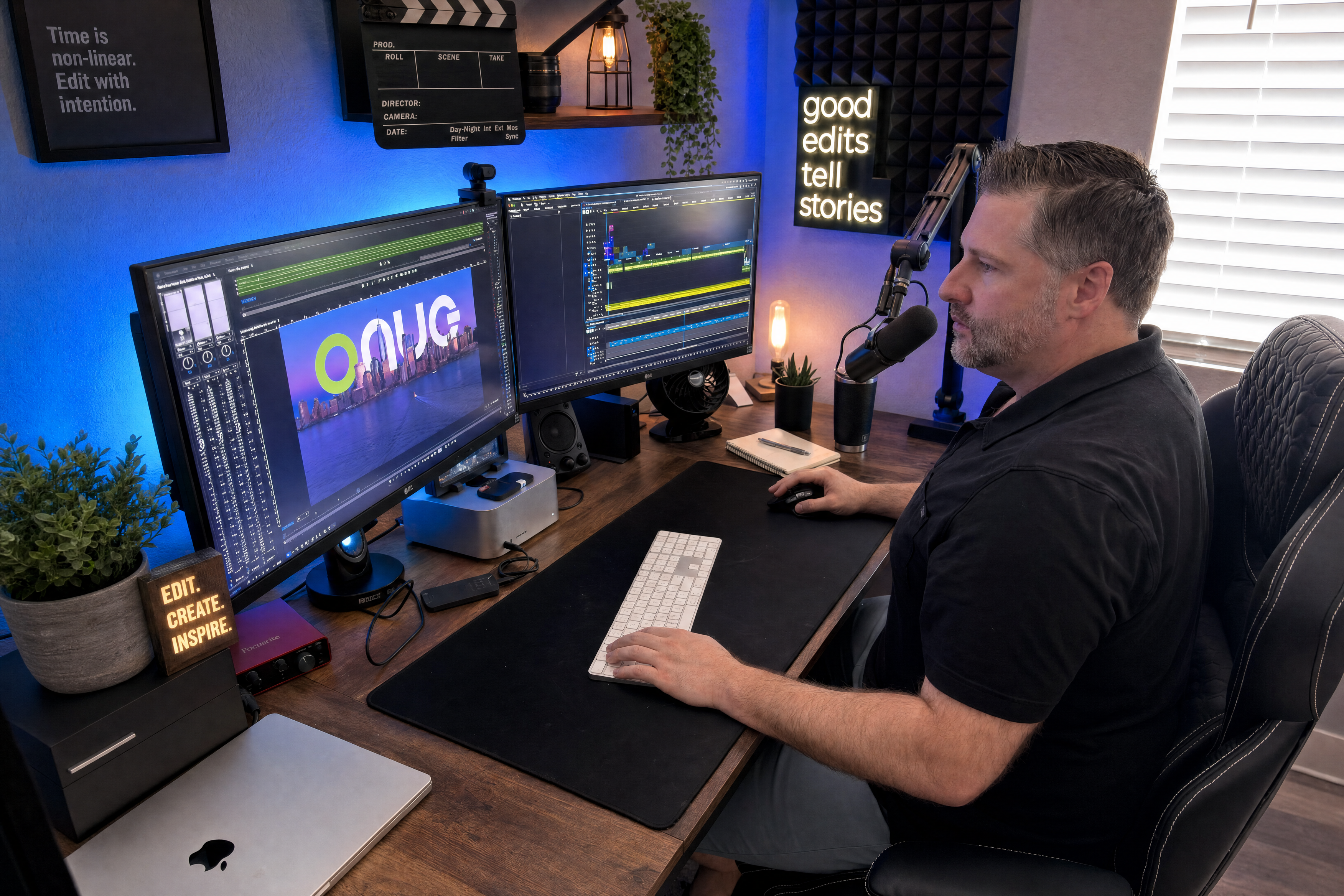
A skilled editor uses AI as a precision instrument, not a replacement for judgment. They know when to override the algorithm because their gut says the algorithm is wrong. That instinct is not something you download. It is something you develop over thousands of hours in the timeline.
Editorial Instinct: What It Actually Means
When we talk about instinct in an editor, we are talking about something specific and learnable, but not fast. It is the ability to:
- Identify the one moment in an interview where the subject says something that changes everything, and build the entire piece around it
- Feel the rhythm of a sequence before the music is even selected
- Recognize when a scene is two beats too long and the audience is about to check out
- Know when silence is more powerful than any sound effect or score
- Understand how color, pacing, and sound design work together to create a unified emotional experience
- Decide what to cut completely, even if it took half a day to shoot
That last point is where a lot of inexperienced editors and content creators fail. They are attached to everything they shot because they were there when it happened. A skilled editor has no such attachment. Their only loyalty is to the story and to the audience watching it.
The Editing Floor Is Where the Story Is Really Written
The phrase "we will fix it in post" has become a punchline. But the truth buried in that cliche is that post-production genuinely is where a large portion of storytelling decisions are made and should be made. Legendary directors have said repeatedly that a film is written three times: once in the script, once on set, and once in the edit. The same principle applies to brand videos, documentary content, podcast clips, case study films, and social media series.
Leaving strong material on the cutting room floor is not waste. It is discipline. It is the editor's job to protect the audience's time and attention by keeping only what earns its place in the final cut. Every second that does not move the story forward, build emotion, or deliver value to the viewer is a second that pushes them toward clicking away. A skilled editor knows this in their bones.
One Great Piece Beats a Hundred Forgettable Ones
The content marketing world has been sold on volume for years. Post every day. Fill the feed. Stay top of mind. And while consistency matters, the obsession with output has produced an internet so oversaturated with mediocre content that audiences have become expert at ignoring it. Scroll speed is now a survival skill.
What actually breaks through is quality. Specifically, it is the quality of the story and how it is told. One video that is genuinely moving, genuinely useful, or genuinely surprising will generate more trust, more shares, and more business than a hundred quick-cut reels assembled from a template. People remember things that made them feel something. They forget everything else almost immediately.
This is not a romantic argument against modern content strategy. It is a practical one. Your production budget, your time, and your audience's attention are all finite. Investing them in fewer, better pieces executed by people who know exactly what they are doing produces a better return than flooding the zone with content that no one will remember by tomorrow.
In a World of Noise, Storytelling Is the Competitive Advantage
We are producing more video content globally than at any point in human history. Barriers to recording have essentially disappeared. Every phone is a camera. Every laptop has editing software. And yet, the gap between what most people produce and what actually commands attention has never been wider.
The reason is storytelling. Not production value in the superficial sense, though great cinematography certainly helps. The deeper differentiator is the ability to take complex information, real human experience, or a brand's genuine value and shape it into something that unfolds with intention. Something that has a beginning that hooks, a middle that builds, and an end that lands. That is what a skilled editor delivers, and it is increasingly rare in a landscape where speed is treated as the only virtue.
At Mainstage Multimedia, our approach has always been that the edit is not a step in the process. It is the process. Every shoot we produce is built with post-production in mind from the first conversation. We know what we are cutting to before we ever press record. That is what a full-service production studio does differently from someone who just shows up with a camera.
What to Look for in a Video Editor or Production Partner
If you are evaluating whether your current video content is getting the editorial attention it deserves, ask these questions:
- Does your editor understand the goal of the piece before they touch the timeline?
- Can they articulate why they made a specific cut, not just that they made it?
- Do they push back when something is not working, even if you shot it?
- Are they thinking about sound design, music, pacing, and color as a unified whole?
- Do they know what to remove, not just what to include?
If the answer to any of those is unclear, your content is not reaching its potential. A full-service production partner like Mainstage brings all of those capabilities under one roof, with a creative lead who has the experience to make those calls and the conviction to stand behind them.
The Bottom Line
Post-production expertise is the most underrated investment in content strategy because its impact is invisible when done well. A great edit does not announce itself. It simply keeps people watching, feeling, and remembering. The craft is in making it look effortless, and effortless is the hardest thing to pull off.
Use every tool available to you. Embrace what technology makes faster and smarter. But never confuse access to tools with mastery of the craft. The best storytelling will always win, and behind every piece of content that truly wins, there is a skilled human editor who knew exactly which frame made the difference.