


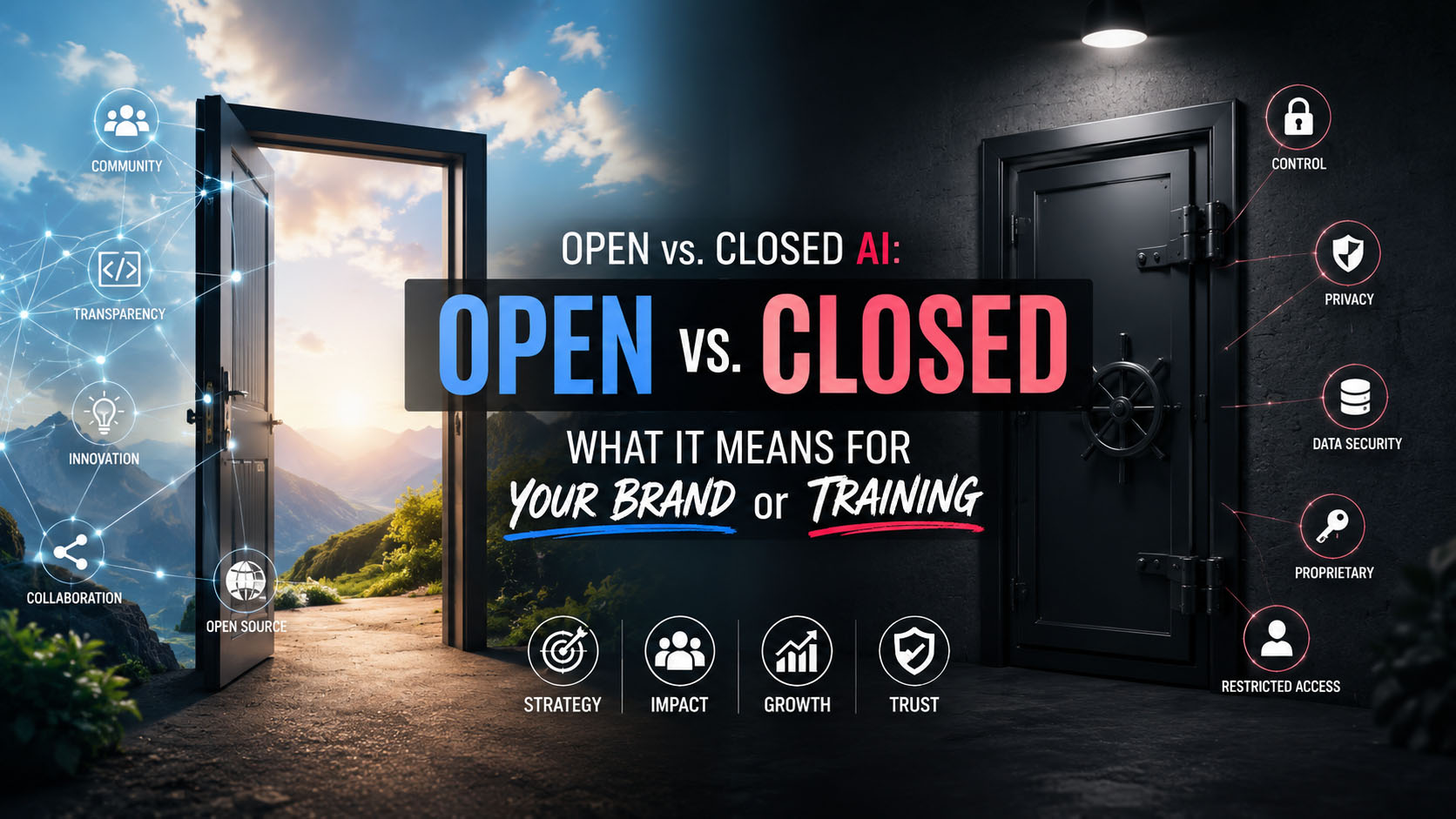
When you hire a production partner that uses AI, you are not just buying speed. You are making a decision about who owns your content, who can see your scripts and brand assets, and how fast the work can actually move. The open vs. closed AI debate matters to your next brand film or training video for exactly those reasons.
Why This Debate Is Reaching Marketing and L&D Desks
The technical community has been arguing about open versus closed AI for some time, but it moved into a much bigger spotlight when leaders across the industry began staking out very public positions. On a recent episode of Moonshots with Peter H. Diamandis, Diamandis and his guests, including futurist Salim Ismail, AI researcher Alexander Wissner-Gross, and technology strategist Dave Blundin, dug into what this split actually means for how AI gets built and deployed going forward.
The conversation reflects something real: the tools your production partner uses are no longer a back-office technical detail. They shape the deliverable, the timeline, and the risk profile of your project.
What "Open" and "Closed" Actually Mean
A closed AI model runs on a company's proprietary servers. You access it through an API or a product interface. The model's weights, meaning the core of what it knows and how it thinks, are not available to the public. OpenAI, Anthropic, and Google's flagship products all work this way.
An open-weight model releases those weights publicly. Anyone can download, run, and modify the model on their own hardware. Meta's Llama family is the most prominent example. Running an open-weight model locally means your data never leaves the machine.
The distinction matters for three concrete reasons: data privacy, customization, and cost at scale.
What This Means for Brand Films and Marketing Video
Brand video production involves a lot of sensitive material before a single frame is shot: creative briefs, messaging strategy, competitive positioning, unreleased product details. When a production partner uses a closed cloud model to draft scripts, generate concept boards, or develop storyboards from that input, that content passes through a third-party server.
For most brand campaigns, that is an acceptable tradeoff. The closed models, at least today, tend to be more capable at nuanced creative writing and visual reasoning. The speed gain is real. But if your brand brief contains anything you would not want indexed or stored externally, open-weight or locally run tools are the safer choice.
At Mainstage, we treat this as a case-by-case judgment call, not a blanket policy. A campaign for a consumer product launch may be fine using capable cloud tools. A confidential internal rebrand or an announcement tied to a pending filing is not.
What This Means for Corporate Training and E-Learning Video
The stakes get higher in e-learning and corporate training video. Training content often contains proprietary processes, compliance procedures, internal policy language, and in some industries, information that is regulated. Feeding that content into a closed model to help write narration scripts or generate knowledge-check questions introduces real risk.
Open-weight models, run on a local or privately hosted server, solve this. The content stays inside your environment. The tradeoff is that the locally run model may require more prompt engineering and editing to match the quality of a top-tier closed model. That is a production skill, not just a technology choice. A good producer knows how to get strong output from either tool.
Speed is real either way. AI-assisted script drafting, voiceover alignment, and chapter structuring genuinely compress timelines. The question is whether you are trading security for that speed unnecessarily.
IP Ownership: A Question Your Production Partner Should Answer Clearly
When AI generates part of a deliverable, who owns it? The answer depends on which tool created it and under what terms.
Most closed-model providers give the customer rights to the output, with caveats. But those terms change, and they vary by tier and use case. Open-weight models, especially when run locally or on privately hosted infrastructure, leave far fewer ownership questions open. The output is yours, produced on your hardware or your production partner's dedicated environment, under no third-party license ambiguity.
For any deliverable Mainstage produces, we are clear about which tools touched the work and what rights the client holds. That is a baseline expectation, not a premium add-on. Clients own their finished work, period.
Speed: Where Open and Closed Models Actually Differ in Practice
Closed models tend to be faster to produce polished first drafts. The instruction-following is more reliable, and the output requires less cleanup. For time-sensitive projects, such as a product launch video or a rapid-turn compliance update for a training course, that matters.
Open-weight models can match or exceed that quality with the right prompt engineering and a skilled producer directing the output. They also enable custom fine-tuning, so a model can be trained on your brand voice, your terminology, and your specific content style. Over a long engagement, that investment pays off in output that sounds like you, not like a generic AI.
The practical answer is that a well-run production shop uses both, choosing the right tool for the right moment, much like choosing the right camera lens for the right shot.
Questions to Ask Your Production Partner Before You Start
- Which AI tools will you use on this project, and are they cloud-based or locally run?
- Does any part of our brief, script, or assets pass through a third-party server?
- Who owns the AI-assisted portions of the deliverable?
- Can you adapt your toolchain if our content is sensitive or regulated?
- How does your use of AI affect timeline and cost, and can you show me where the time savings come from?
A production partner who cannot answer these questions clearly is either not using AI thoughtfully or has not thought through the implications for you. Both are problems.
How Mainstage Thinks About This
We are producers first. AI is a production tool, the same way a color grading suite or an audio mixing board is a production tool. The goal is always the finished deliverable: a brand film that earns attention, a training course that changes behavior, a campaign that moves the business.
We use AI to move faster and to sharpen the work, specifically in scripting, structure, motion graphics, and post-production workflows. We choose open or closed tools based on what the project demands. We never make that choice for convenience at the expense of your IP or your data security.
Whether you are planning a brand film or commercial or building out a library of corporate training videos, the AI layer underneath the production should be invisible to your audience and fully transparent to you.
If you want to talk through what a production built on the right tools, used the right way, looks like for your next project, we would be glad to have that conversation. Book a call with our team and let us show you how we work.