


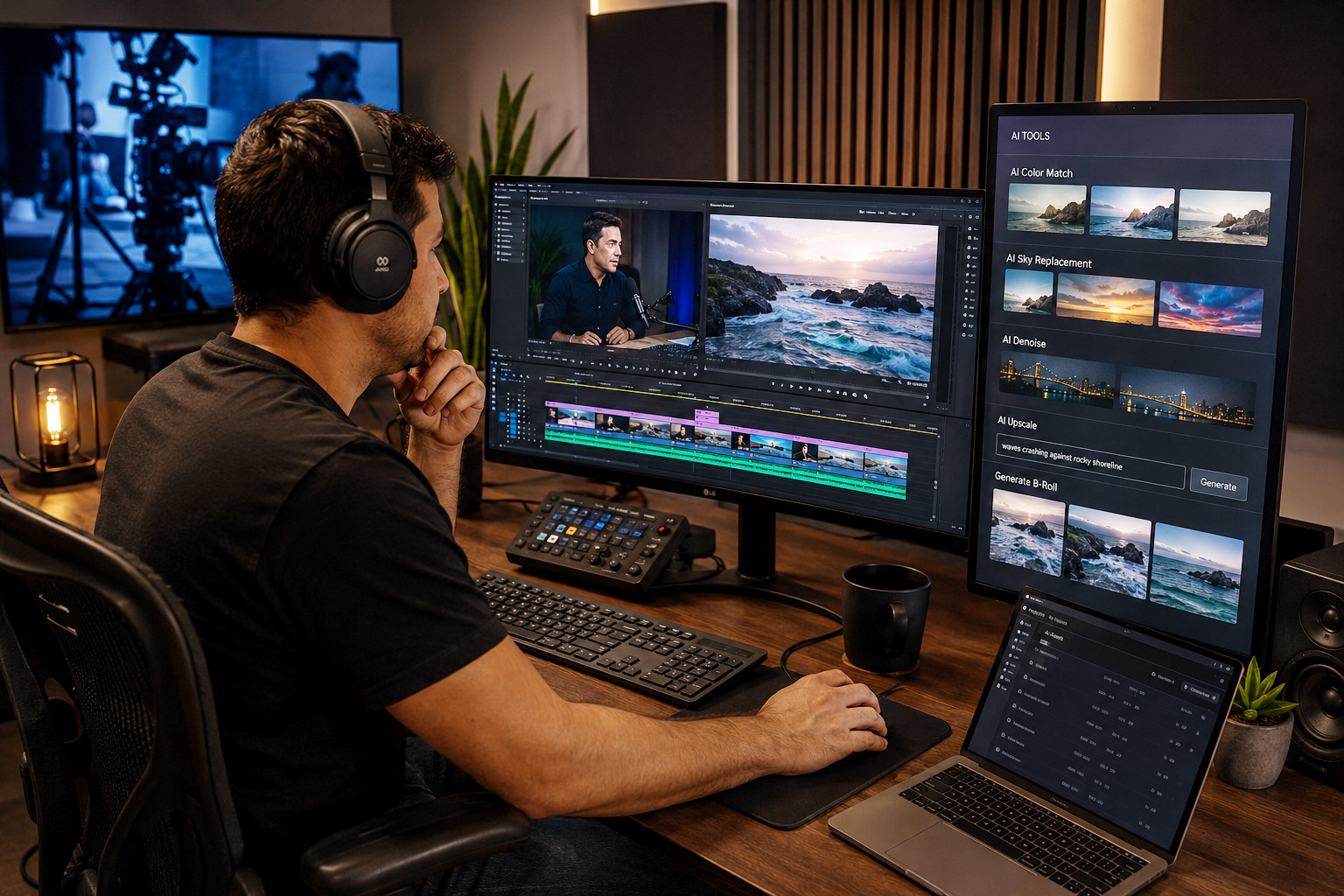
A responsible production studio should evaluate every AI tool against three questions before it touches a single client project: Does it make the work measurably better or faster? Does it put client data or brand assets at risk? And does a human still control every creative decision? If any answer is unclear, the tool waits outside the door.
That is not caution for caution's sake. It is what a producer-led process actually looks like when AI enters the room.
TL;DR: AI can do real, useful work inside a video production pipeline, but only when a studio has a clear framework for which tools it trusts and why. Mainstage evaluates every tool for speed, quality, and data safety before it touches client work. Humans direct. AI executes. The client owns the result.
Why the AI Tool Question Is Now a Client Question
Not long ago, the conversation about AI risk lived mostly in tech circles. That changed quickly. In a recent episode of the All-In Podcast, Jason Calacanis, Chamath Palihapitiya, David Sacks, and David Friedberg worked through a genuinely rigorous debate about how organizations should assess the risk profile of AI models before deploying them. The panel's core tension was this: the tools that move fastest are often the ones whose data practices, training sources, and liability exposure are least transparent.
That tension is not abstract for a production studio. When a brand hands us footage of unreleased products, scripts containing proprietary messaging, or talent releases with personal data attached, the question of which AI system touches those files is a real business decision with real consequences.
Clients are starting to ask. They should be.
The Three-Part Framework We Actually Use
Here is how Mainstage thinks through every AI tool before it enters our pipeline. This is not a checklist we wrote for a blog post. It is the set of questions that comes up in real production conversations.
1. Speed: Does It Save Time a Human Would Otherwise Waste?
The only AI tools worth adopting are the ones that compress time on work that does not require human judgment, so that human judgment can go somewhere more valuable.
In a video production context, that means tasks like:
- Generating a first-pass rough cut from a long interview so an editor can start with structure instead of starting from raw footage
- Transcribing dialogue for caption and subtitle files
- Drafting a first pass of lower-third text or script outlines for review
- Batch-resizing or reformatting deliverables for multiple platforms
None of those decisions require a creative call. They require accuracy and speed. AI earns its place there.
What it does not earn: choosing the shot, writing the story, directing the performance, or deciding what the brand sounds like. Those stay with our producers and directors, every time.
2. Quality: Does the Output Actually Meet the Standard?
Speed means nothing if the output requires more cleanup than a human would have spent doing it right the first time. We test every tool against real production material, not demo reels, before we trust it on client work.
Some AI audio cleanup tools, for example, are genuinely excellent on voice-over recorded in a treated room. The same tools can introduce artifacts on location sound from a busy hotel lobby or a trade show floor. Knowing which is which comes from testing, not from reading a feature list.
The standard we hold AI output to is simple: would a senior editor or producer approve this without flagging it? If the answer requires a caveat, the tool either stays in testing or gets used only in contexts where it performs cleanly.
3. Data Safety: What Happens to the Files We Feed It?
This is the question the All-In panel pressed hardest, and it is the one most studios skip because it feels like an IT problem. It is not. It is a client trust problem.
When you upload footage or a script to a cloud-based AI tool, you need to know:
- Is that content used to train the model?
- Where is it stored, and for how long?
- What are the terms of service if the tool provider is acquired or changes its policy?
- Does the tool's country of origin or data residency create any exposure for the client?
As Chamath Palihapitiya and David Sacks both pressed in the episode, the risk of a given AI model is not only about capability. It is about who controls the data that flows through it and what accountability exists when something goes wrong.
Our default is simple: client files that contain unreleased creative, proprietary brand assets, or personally identifiable information do not go into any tool whose data handling we cannot verify. We use locally run models or enterprise-tier platforms with explicit data isolation agreements where those conditions apply. If a client's legal or compliance team has requirements, those requirements win. Full stop.
Who Still Directs Every Decision
The word that keeps getting lost in AI conversations is "direction." A tool can generate a version of something. A director decides whether that version serves the story, the audience, and the brand. Those are not the same job.
At Mainstage, every project runs under a producer and director who owns the creative outcome from brief to delivery. AI tools operate inside that structure. They do not replace it. A rough cut that AI assembles in twenty minutes still gets pulled apart and rebuilt by an editor who knows what the scene needs to feel. A transcript that AI produces in seconds still gets proofread by a human who catches the brand name it mangled.
The result is that AI makes us faster without making us careless. Clients get the speed benefit without absorbing the quality or data risk that comes from a studio that grabbed whatever tool was trending and pointed it at the timeline.
What This Looks Like in Practice
A few concrete examples of how the framework plays out on real production types:
Brand films and commercials: AI assists with transcription, caption generation, and platform-specific reformatting. Story structure, pacing, music selection, and color work are human-directed throughout. Client footage never touches a public-facing AI model without explicit review of that tool's data terms.
E-learning and corporate training video: AI can accelerate script formatting, slide-to-narration timing, and accessibility file generation. The instructional design logic, the voice and tone calibration, and the learner experience decisions stay with our producers. Proprietary training content is treated with the same data caution as any confidential asset.
Podcast production: AI transcription and noise reduction tools are genuinely useful here and are among the most mature in the space. We vet them for accuracy on different accent profiles and recording environments before they become standard in a client's workflow.
The Honest Trade-Off
Being selective about AI tools means we occasionally move slower than a studio that uses every new release the day it drops. We are fine with that. The clients who hire us are not buying speed in a vacuum. They are buying a finished result they can trust, own, and put their name on.
Jason Calacanis made a version of this point in the All-In episode: appetite for AI risk scales with the stakes of the decision. A low-stakes internal memo is a different conversation than a customer-facing campaign or a regulated training program. The framework has to match the stakes.
Ours does. And we are happy to walk any client through exactly which tools we use, why, and what we do not use and why.
Ready to Work With a Studio That Has Thought This Through?
If you are planning a video project and want to know how we would approach it, including which parts AI helps with and which parts stay entirely human-led, explore our video production work or reach out to book a call with David and the Mainstage team. We will show you the framework in the context of your actual project, not a generic pitch.