



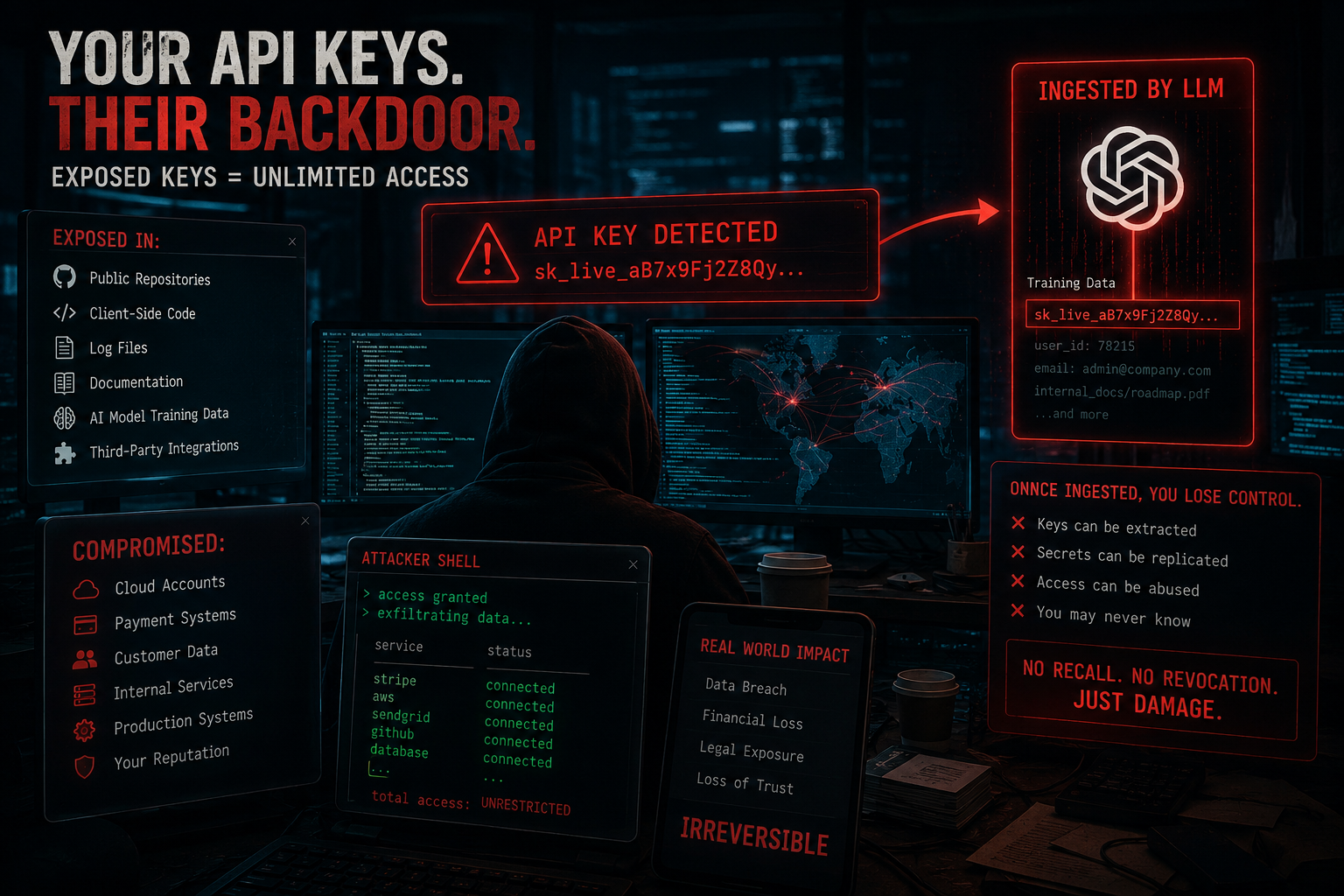
If you are building AI-powered tools or websites using Claude Code, OpenAI Codex, or any other large-language-model API, your secret API keys are the single most dangerous piece of information in your project. One exposed key can drain your API credits in hours, compromise your user data, or give an attacker a backdoor into every service connected to that credential. The good news: this is a completely preventable problem when the right processes are in place from day one.
What Is a Secret API Key and Why Does It Matter?
When you connect to an AI service like Anthropic's Claude or OpenAI's Codex, the provider gives you a secret API key. Think of it as a password that authorizes every request your application makes. The moment someone else has that key, they can make requests on your behalf. Your billing account pays for it. Your rate limits get consumed. Your data pipelines get accessed.
Unlike a stolen password, a compromised API key does not always trigger an obvious alarm. Usage can spike quietly. Attackers can scrape your endpoints, pull sensitive outputs, or resell your access on gray-market forums before you notice anything unusual.
How Keys Get Exposed: The Most Common Mistakes
You do not have to be careless for this to happen. You just have to be in a hurry, which describes almost every self-taught builder or small team racing to launch something new.
- Hardcoding keys directly into source files. A developer pastes the key into the code to test quickly and forgets to remove it before pushing to GitHub. GitHub's own scanning tools catch millions of exposed secrets every year, but not before bots have already harvested them.
- Sharing keys over Slack, email, or chat. When a team member needs access, the fastest path is a quick message. That message now lives in a log, a screenshot, a forwarded thread, or a chat history with no expiration date.
- Committing a .env file to version control. Environment files are meant to stay local and out of git. A missing or misconfigured .gitignore means that file goes public with one push.
- Pasting keys into AI prompts or shared notebooks. When you paste your key directly into a Claude Code session or a shared Jupyter notebook to test a workflow, that key can appear in logs, history files, or collaborative workspaces others can view.
- No key rotation or expiration policy. Even if a key was never exposed, using the same credential for months or years means a delayed breach goes undetected longer than it should.
Why DIY Builds Are Especially Vulnerable
Founders, marketers, and content teams reaching for Claude Code or Codex to build internal tools, custom dashboards, or AI-enhanced websites are often working fast and working alone. That is a recipe for skipping the steps that feel like overhead but are actually essential.
There is no security review. There is no infrastructure policy. There is no one asking, "Where are we storing that key and who has access to it?" The person writing the code is the same person approving it, testing it, and shipping it. That closed loop removes every checkpoint that would normally catch a mistake before it becomes a breach.
The vulnerability is not a reflection of intelligence or effort. It is a structural problem. One person cannot simultaneously be the developer, the architect, the security reviewer, and the project manager. When you try to be all of those at once, something gets skipped. Security is usually the first thing.
What Best Practice Actually Looks Like
A professional production team working on AI-integrated web builds or custom tools follows a set of practices that make key exposure structurally difficult, not just a matter of remembering to be careful.
- Keys never touch source code. Credentials live in environment variables, secrets managers, or platform-level configuration systems. The code itself contains no sensitive values at any stage.
- Access is scoped and role-based. Not every team member needs every key. Access is granted based on what each person actually needs to do their job, and no more.
- Keys are rotated on a schedule. Regular rotation limits the damage window if a key is ever silently compromised. Old keys are revoked, not just forgotten.
- Version control is configured before the first commit. .gitignore files, repository visibility settings, and branch protections are set up at project kickoff, not patched in after the fact.
- Monitoring is in place from launch. Usage anomalies, unexpected API calls, and access from unfamiliar IP ranges trigger alerts rather than going unnoticed for weeks.
- Secrets are never shared over unsecured channels. When credentials must be transferred, they move through dedicated secrets management tools, not email or Slack.
How Mainstage Approaches AI-Integrated Builds
At Mainstage, our AI-accelerated web design and development work is producer-led from the first conversation. That means security architecture is not an afterthought we bolt on before delivery. It is part of the project plan before any code is written.
We use AI tools, including Claude-based workflows, to move faster on design, content, and development. But every integration is built by a team that understands what is at stake when those tools connect to live credentials, real data, and client-owned infrastructure. You are not handing your API keys to a freelancer who will figure it out as they go. You are working with a team that has a process.
You also own everything we build. The codebase, the credentials structure, the documentation. When we hand off a project, you are not dependent on us to keep the lights on. You have a secure, well-documented system your own team can operate and maintain.
The Real Cost of Getting This Wrong
A compromised API key tied to a Claude or Codex integration is not a hypothetical problem. The costs are concrete:
- Unexpected API bills that can climb into thousands of dollars before you notice
- Unauthorized access to any service your key connects to, which may include databases, CRMs, or payment systems
- Reputational damage if user data is exposed through a tool you built and shipped
- Time lost investigating, rotating credentials, auditing logs, and cleaning up access that should never have been granted
None of that is recoverable with an apology. It requires real remediation work, and often a rebuild of the trust you spent years earning with your audience or customers.
If You Are Building Right Now, Start Here
If you are mid-project and doing this yourself, the most important steps you can take immediately are:
- Audit every file in your repository for hardcoded keys or credentials.
- Revoke any key that has ever been shared over chat, email, or included in a prompt.
- Generate new keys and store them only in environment variables or a secrets manager.
- Review your .gitignore and confirm your .env file is excluded from version control.
- Set up usage alerts in your API provider dashboard so spikes trigger a notification.
These steps reduce your exposure immediately. But they do not replace the value of having a team that sets this up correctly from the start, so you never have to run a breach audit in the first place.
If you are planning a build that will use AI APIs, custom dashboards, or any credential-dependent integration, we would be glad to talk through the approach. Explore what a producer-led AI web build looks like or reach out to book a call with David and the Mainstage team.