


Most brands treating AI as a chatbot are leaving the majority of its value on the table. The real shift is not asking AI a question; it is deploying AI agents as active members of a production team, each one owning a repeatable task so the human producer can stay focused on strategy and craft. That is exactly the model Mainstage Multimedia runs today for video and podcast clients, and it changes what is possible in terms of speed, consistency, and output quality.
Why "Using AI" Is Not Enough
Reid Hoffman, speaking with Marina Mogilko on the Silicon Valley Girl podcast, made the point that most people who think they are using AI are barely scratching the surface. His argument is that the coming wave is not about a single AI assistant; it is about deploying a coordinated team of AI agents, each handling a defined role, working in parallel, and handing off to the next.
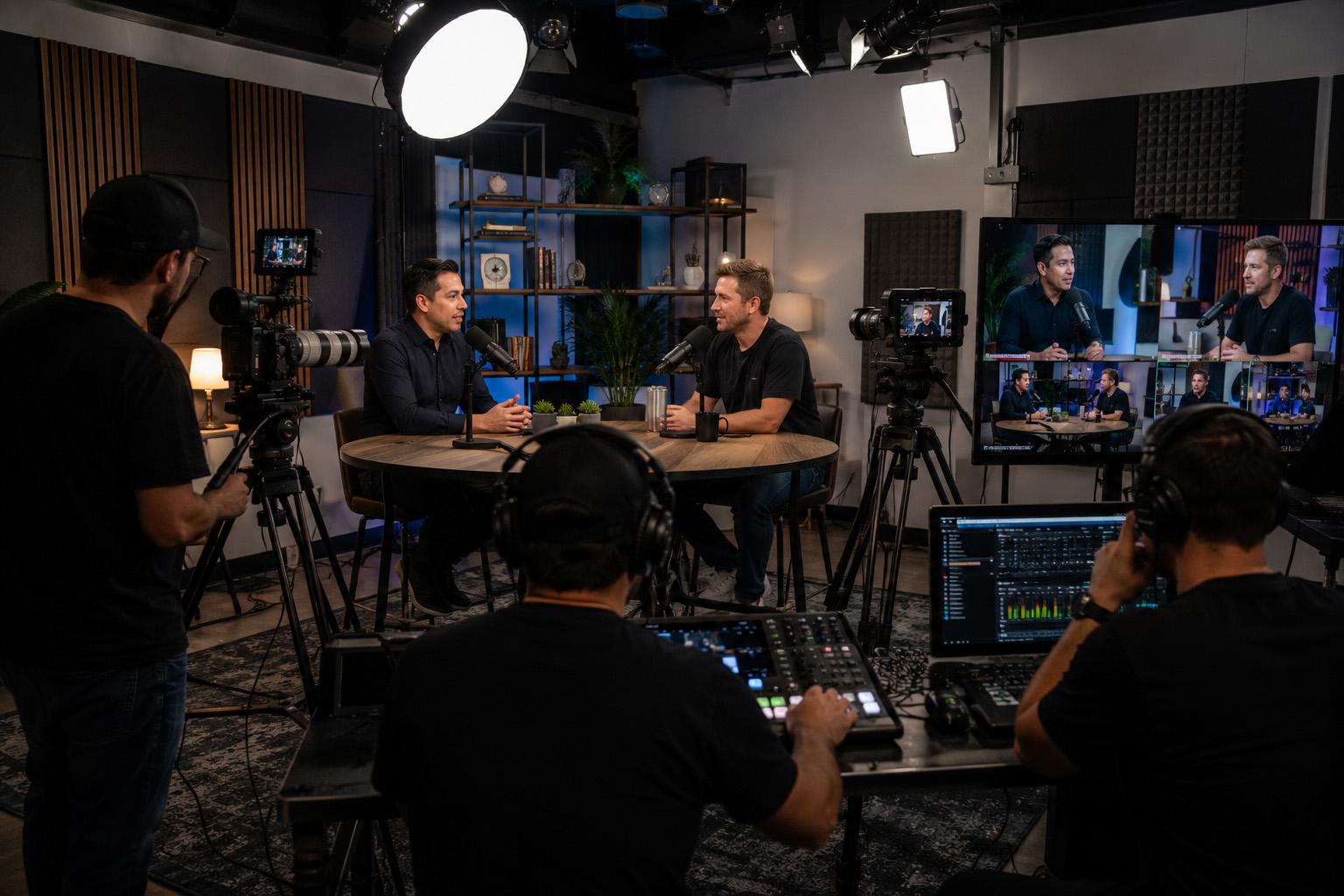
That framing maps almost perfectly onto how a professional production workflow is already structured. Video and podcast production has always been a team sport: a researcher, a writer, a scheduler, an editor, a quality reviewer. The question is not whether AI fits into production. The question is which roles it can own reliably, and which roles demand a human with taste, judgment, and accountability.
At Mainstage, our answer is clear. AI handles the repeatable. Humans handle the irreplaceable.
What AI Agents Actually Do Inside a Production Workflow
Here is what this looks like in concrete, practical terms across a video or podcast production engagement.
Research and Briefing
Before a single frame is shot or a microphone turned on, every project needs a brief: who is the audience, what do they already believe, what do they need to feel, what does the competitive landscape look like. Traditionally this takes days of manual work. An AI agent can be given a focused prompt and a set of sources, and it will surface patterns, identify knowledge gaps, and draft a structured briefing document in a fraction of the time.
Our producers still review and shape that brief. But they are reacting to a solid first draft rather than building from a blank page. That shift alone compresses timelines significantly.
Scripting Support and Outline Development
AI does not write our scripts. Our producers do. But AI agents serve as relentless first-draft partners. They can generate multiple structural approaches to the same episode or video, propose interview questions mapped to specific audience outcomes, and flag when an argument is missing a logical step.
The key is treating the AI output as raw material, not finished work. A producer with years of experience knows when a hook is weak, when an explanation needs a real example, and when the tone is off for the brand. AI accelerates the iteration; the producer controls the quality.
Scheduling and Project Coordination
Production logistics are time-consuming and error-prone when managed manually. AI agents are exceptionally good at holding a production calendar together: tracking deliverables, flagging when a deadline is at risk, drafting communications, and keeping all stakeholders aligned without anyone falling through the cracks.
For clients who produce ongoing content, whether a weekly podcast or a monthly video series, this kind of coordination layer is what keeps a content engine running consistently instead of stalling between episodes.
Post-Production Workflows
This is where AI acceleration becomes most visible to clients. Transcription that once took hours is now near-instant. Rough-cut assembly based on a transcript, pulling the strongest moments from a long interview, can be guided by AI tooling that our editors then refine. Show notes, chapter markers, social media cut-downs, and SEO-ready descriptions can all be drafted from a finished episode transcript before an editor has finished color correction.
None of this removes the editor. It removes the low-value repetition so the editor can spend their time on the decisions that actually affect how the finished piece feels to the viewer or listener.
The Role That AI Cannot Fill
Hoffman's broader point, as Mogilko drew out in their conversation, is that deploying agents well requires a clear-eyed view of what agents are for. They execute. They do not lead.
In production, someone still has to decide what the video is actually trying to accomplish. Someone has to know when a performance is flat and needs another take. Someone has to push back when a client's requested cut will hurt their credibility with the audience they are trying to reach. Someone has to own the finished result.
That is the producer. At Mainstage, that is always a human being with experience and accountability, supported by AI that makes the work faster and the output richer.
What This Means for Clients
For marketing leaders, L&D managers, and executives commissioning video or podcast content, the practical implication is straightforward. A production partner who has integrated AI agents into their workflow is not cutting corners. They are removing the bottlenecks that used to make content expensive to produce consistently.
That means faster turnaround from brief to delivery. It means your producer is spending more hours on creative judgment and less on administrative assembly. And it means a content program that can scale, whether you are building a single flagship brand film or a long-running podcast series, without proportionally scaling cost.
You still get a finished, fully produced asset that you own outright. The process just runs smarter underneath it.
The Mainstage Approach
We built our workflow around a simple principle: AI handles the repeatable tasks with speed and consistency, and our producers stay in creative and strategic control at every decision point. That is not a future aspiration. It is how we run projects today for video and podcast clients, from concept through delivery.
If you are ready to see what a producer-led, AI-accelerated workflow looks like for your next project, explore our video production and podcast production services, or reach out to start a conversation with our team.