



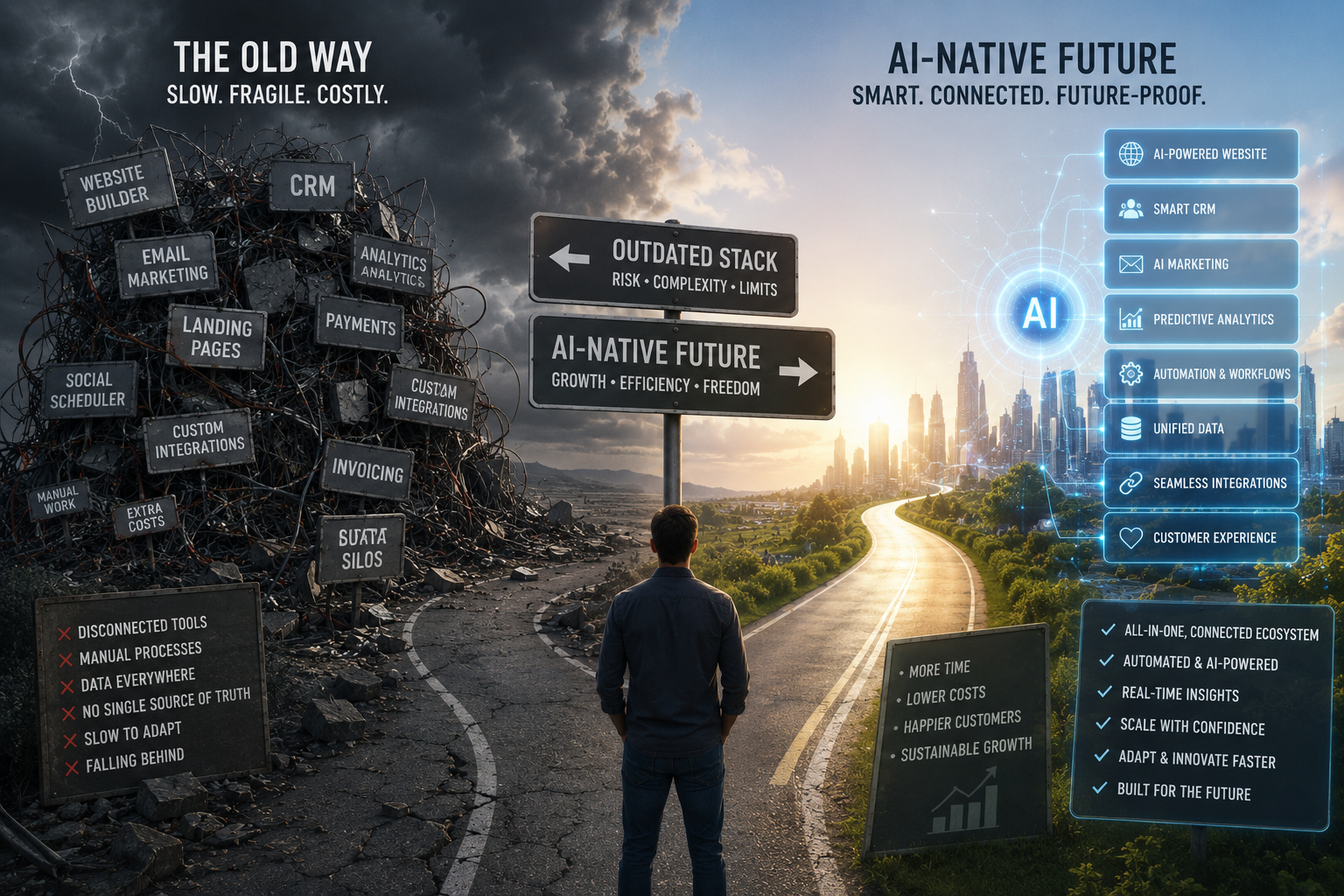
Going AI-native means building your business around AI tools from the ground up, rather than bolting them onto a stack that was already too complicated. For solopreneurs and small teams, that shift is not just possible right now. It is one of the biggest competitive advantages available to you, and you do not need a large budget or an IT department to pull it off.
What "AI-Native" Actually Means for a Small Business
AI-native does not mean you replace every human on your team with a chatbot. It means AI is woven into how you work by default, not treated as a special add-on you open once a week.
A traditionally run small business might use ten or twelve separate software subscriptions to handle marketing, scheduling, invoicing, analytics, communication, and design. An AI-native business consolidates that stack, automates the connective tissue between tools, and uses AI to handle drafting, analysis, and routine decision-making so the humans on the team can focus on strategy and relationships.
The difference is not just efficiency. It is clarity. When your systems are leaner, you actually understand what is happening in your business. That matters more than any single feature any piece of software ever promised you.
The Software Bloat Problem Is Costing You More Than Money
Most small businesses carry a software stack they assembled one problem at a time. A project management tool here, a social scheduling tool there, an analytics plugin that someone set up two years ago and nobody fully understands anymore.
Every one of those tools has a login, a subscription fee, a learning curve, and a support queue. More importantly, each one holds a piece of your business data in a silo you do not fully control.
Software bloat costs you time every single day. It costs you the mental overhead of remembering which tool does what. It costs you the hours you spend reconciling data from three different dashboards that all tell you slightly different things. And it costs you the confidence of never quite knowing which number to believe.
Going AI-native forces a useful audit. You look at every tool you pay for and ask: does this do something AI cannot handle now, or can we consolidate? For most small teams, that audit alone frees up meaningful budget and mental bandwidth.
Data Sovereignty: Own What You Know About Your Business
Here is a question worth sitting with: if you cancelled every software subscription you have tomorrow, what data would you actually keep?
Most SaaS platforms retain your data in their ecosystem. Your customer records, your analytics history, your content performance data. It lives in their infrastructure, formatted their way, exportable only in whatever shape they decide to allow. That is not ownership. That is tenancy.
Data sovereignty means your business intelligence lives somewhere you control, in a format that works for you, accessible without a middleman. For a solopreneur or small team, that might look like a custom analytics dashboard that pulls from your own sources and displays exactly the metrics that drive your decisions.
This is something Mainstage builds directly for clients as part of our AI-accelerated web design and development work. When we build a dashboard for you, you own it outright. There is no monthly license for the privilege of seeing your own numbers. That is a meaningful difference.
Practical Steps to Start Going AI-Native Today
You do not have to overhaul everything at once. The smartest approach is to move in stages, starting with the areas where time loss is most visible.
- Audit your stack. List every tool you pay for and every tool you use for free that holds your data. Note what each one does and how often you actually use it. You will find overlap and redundancy almost immediately.
- Identify your highest-friction workflows. What tasks eat the most time for the least strategic return? Content drafting, scheduling, reporting, and client follow-up are common answers for small teams. Those are your first automation targets.
- Consolidate before you add. Resist the urge to add another AI tool on top of your existing stack. The goal is reduction. Look for AI-powered tools that replace two or three things you already pay for.
- Build for ownership from the start. When you invest in a website, a dashboard, or a content system, make sure you own the output. Platforms that lock your assets behind proprietary formats will cost you later.
- Create a simple content engine. AI makes it practical for a one- or two-person team to maintain a real content presence. A short podcast, a monthly video, a consistent newsletter. The key is building a workflow that produces it without requiring a heroic effort every single time.
- Use AI for analysis, not just production. The biggest leverage point is not having AI write things for you. It is having AI surface patterns in your data, flag anomalies, and summarize what is actually working. That is where the strategic value lives.
Where Human Craft Still Wins
AI accelerates. It does not replace judgment, relationships, or creative vision. Small teams that go AI-native and win are not the ones who automate everything. They are the ones who get ruthlessly clear about where human attention creates the most value, and then use AI to protect that time.
Your brand voice is human. Your client relationships are human. Your ability to read a room and make a call based on incomplete information is human. A well-built AI-native operation clears away the administrative noise so those human skills can actually do their job.
At Mainstage, we use AI to move faster on research, drafting, design iterations, and data analysis. But every strategy is set by a human, every client conversation is led by a human, and every finished deliverable is reviewed and refined by a human. Speed is a means, not the end.
What an AI-Native Web and Brand Presence Looks Like
Your website and your digital brand are often the first place going AI-native pays a visible dividend. An AI-accelerated build means we can move from strategy to a polished, fully functional site in a fraction of the time a traditional agency would take, without cutting corners on design or performance.
More importantly, the site and any connected dashboards are built on infrastructure you own. No proprietary page builders that hold your content hostage. No analytics platform that charges you to access your own history. Just a clean, fast, well-designed digital presence with data flowing into a dashboard that tells you exactly what you need to know.
For solopreneurs and small teams, that kind of professional, ownership-first digital foundation used to be out of reach on budget. AI changes that math significantly. Explore what that looks like for your business at our AI web design and development page.
The Competitive Advantage Is Still Open
Most small businesses are not going AI-native yet. They are experimenting with individual tools but not rethinking how they operate. That gap will not stay open forever. The businesses that build lean, AI-integrated operations now will have a structural advantage that compounds over time, lower overhead, faster output, cleaner data, and more of their best people focused on the work that actually matters.
The barrier to entry is lower than it has ever been. You do not need a big team or a big budget. You need a clear strategy, the right partners, and the willingness to simplify before you scale.
If you are ready to take those steps, we would be glad to map out what an AI-native foundation could look like for your business. Start the conversation here, or reach out to book a call with our team.