



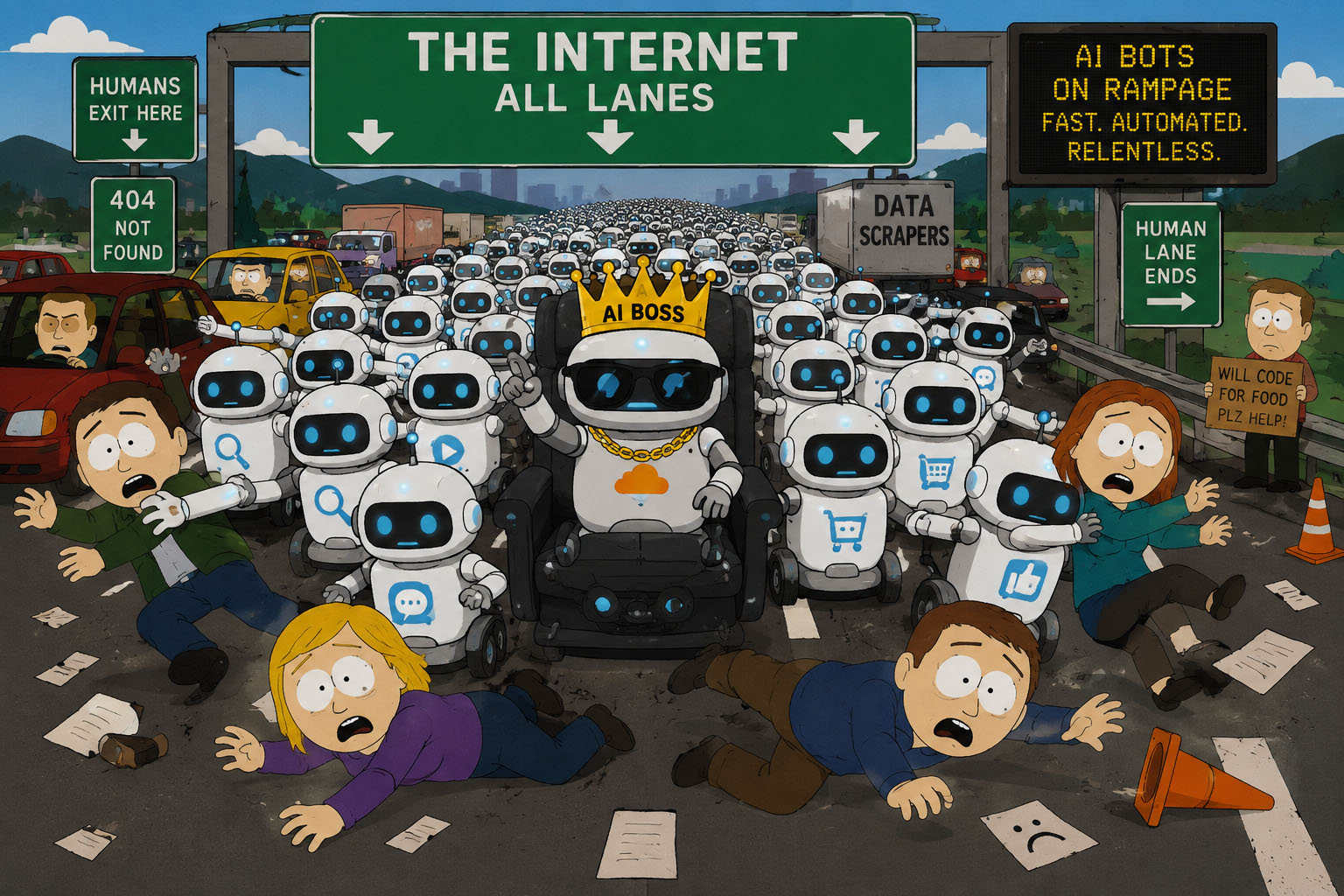
Most of the traffic hitting your website right now is not human. AI agents, crawlers, and automated bots are already the dominant force on the internet, and industry leaders warn that human browsing will soon be a rounding error by comparison. If your website was designed only for human visitors, it is increasingly failing to serve the audience that actually controls what gets surfaced, cited, and recommended.
What Cloudflare's Warning Actually Means for Brands
Cloudflare, which routes and protects a significant share of global internet traffic, has sounded a clear alarm. Its leadership has stated that human visitors are becoming a rounding error compared to the volume of bot and AI agent traffic the web now handles. That is not a distant forecast. It describes the web as it operates today.
Some of that traffic is malicious, the kind Cloudflare works to block. But much of it is legitimate: AI assistants researching on behalf of users, large language models crawling for training data, and automated agents completing tasks that humans used to do manually by visiting pages one at a time.
For a brand, the practical consequence is this: the entity deciding whether your website is trustworthy, useful, and worth citing may never be a human being. It may be a system that reads your page in milliseconds, makes a judgment, and moves on. Your site either passes that test or it does not.
Why Most Brand Websites Are Not Ready
The average business website was designed with a specific visitor in mind: a human who lands on the homepage, browses around, maybe watches a video, and eventually fills out a contact form. That visitor was always somewhat idealized, but now the gap between that assumption and reality has widened into a chasm.
Automated systems do not browse. They read. They extract. They evaluate structure, specificity, and authority at a scale and speed no human matches. Sites that were built to impress a human at a glance often fail to communicate anything meaningful to a system that is actually reading the content.
The most common failure points include:
- Vague, brand-first openings. Pages that spend the first two paragraphs on mission statements and founding stories before explaining what the business actually does. Automated systems want the answer immediately.
- Buzzwords without substance. Phrases like "innovative solutions" and "world-class service" carry no information. A system trying to understand what you offer will find nothing useful there.
- No logical hierarchy. Walls of text without headers, subheadings, or lists are difficult to parse, for machines and for busy humans alike.
- Thin or repeated content. Multiple pages that say roughly the same thing in slightly different words signal low authority to crawlers and AI systems.
- Outdated technical foundations. Slow load times, missing structured data, and poor mobile performance all reduce how much trust automated systems assign to your site.
The Opportunity Hidden Inside the Problem
Here is what is worth recognizing: a website built to communicate clearly with AI agents and bots is also a better website for humans. The qualities that help automated systems understand and trust your content, clarity, structure, specificity, and depth, are the same qualities that help a busy executive or marketing director make a fast, confident decision about whether you are the right partner.
This is not about gaming a system. It is about saying what you mean, organizing it logically, and demonstrating real expertise rather than performing it. The brands that do that well will be the ones that show up in AI-generated answers, in search results, and in the recommendations automated tools surface to decision-makers.
Cloudflare's concern is primarily about the security and integrity of the web as bot traffic scales. For brands, the productive response to the same trend is to make sure your legitimate presence is unmistakably clear, credible, and well-structured, so the right automated systems work in your favor rather than past you.
What a Bot-Ready Website Actually Looks Like
A site built for the current and future web has several non-negotiable qualities.
Direct answers at the top of every page. Whatever question the page is meant to answer, answer it in the first sentence or two. Context and detail follow. This is how AI agents extract useful information, and it is also how time-pressed humans read.
Descriptive, hierarchical structure. Headers are semantic signals, not just visual breaks. They tell automated systems what each section covers and how the page is organized. Each header should reflect a real question your audience asks. Each paragraph should carry one idea.
Concrete, specific language. "We deliver high-quality results" communicates nothing to a system evaluating your credibility. "We produce end-to-end brand films, from concept and script through shoot, edit, and final delivery" communicates a great deal. Specificity is a proxy for trustworthiness.
Depth on the topics that matter most. A site that covers one subject with genuine expertise signals more authority than a site that skims twenty subjects. Pick the areas where your knowledge is real and go deep.
Structured data markup. FAQ schema, organization markup, and other structured data formats put your content in a form that automated systems can read and surface directly. This is not optional for a modern web presence. It is baseline.
Fast, clean technical performance. Page speed, mobile performance, and clean code all factor into how much trust crawlers and AI systems assign to your site. A slow or poorly built site signals neglect, regardless of how good the content is.
What This Means for Video, Audio, and Visual Content
Most automated systems cannot watch a video or listen to a podcast. That does not make visual and audio content less valuable. It makes the supporting text around them more important than ever.
Every video needs a full transcript and a detailed, specific description. Every podcast episode needs show notes that capture the key points and answer the questions a listener or an AI agent might ask. Every image needs accurate, descriptive alt text.
Think of it as two layers working together. Your visual content builds trust and connection with the humans who engage with it. The text surrounding it builds trust with the automated systems that determine whether those humans ever find it in the first place.
When we produce a brand film or commercial, or a podcast series, the transcript, metadata, and supporting copy are part of the deliverable. Not an afterthought. That discipline is part of what makes the work durable, not just beautiful.
Your Website Is Infrastructure, Not a Brochure
For a long time, a business website was treated as a digital brochure: something you built once, refreshed occasionally, and pointed people toward. The bot-and-AI-dominated web makes that model obsolete.
Your website is now infrastructure. It is the mechanism by which your brand is discovered, evaluated, and selected, often by systems that complete that entire process before a human ever sees the result. That means the decisions behind your web presence, what it says, how it is structured, how it performs technically, deserve the same strategic weight as any other major business investment.
A site built on outdated tools, with content that was never designed for automated consumption, is not just aesthetically dated. It is functionally invisible to a growing share of the processes that drive discovery and consideration.
Our AI-accelerated web design and development work is built around this reality. We design and build sites that are fast, structurally sound, rich with the right content signals, and paired with custom analytics dashboards so you can see how they perform. Clients own everything outright, no subscriptions, no lock-in.
Where to Start
If you want to assess how ready your current site is for the bot-and-AI-driven web, here is a practical starting point.
- Read your homepage as if you know nothing about your business. Does it tell a system or a stranger exactly what you do in the first two sentences? If not, rewrite the opening.
- Check your structure. Are your key pages organized with clear, descriptive headers? Are lists actually formatted as lists? Can someone, or something, skim the page and understand the content without reading every word?
- Audit your specificity. Replace every vague claim with a concrete one. What exactly do you do? For whom? With what result?
- Add text around every media asset. Transcripts for video and audio. Detailed descriptions. Accurate alt text for images.
- Test your technical performance. Page speed, mobile experience, and structured data markup all affect how automated systems read and rank your site.
None of this is a one-day project. But it compounds. Every improvement you make builds a web presence that works harder for you over time, with human visitors and with the automated systems that are increasingly shaping what those visitors see.
If you want a team that thinks this way from the first conversation, explore our web design and development work or reach out to book a call. We build web infrastructure that is ready for the internet as it is now and where it is clearly heading.