



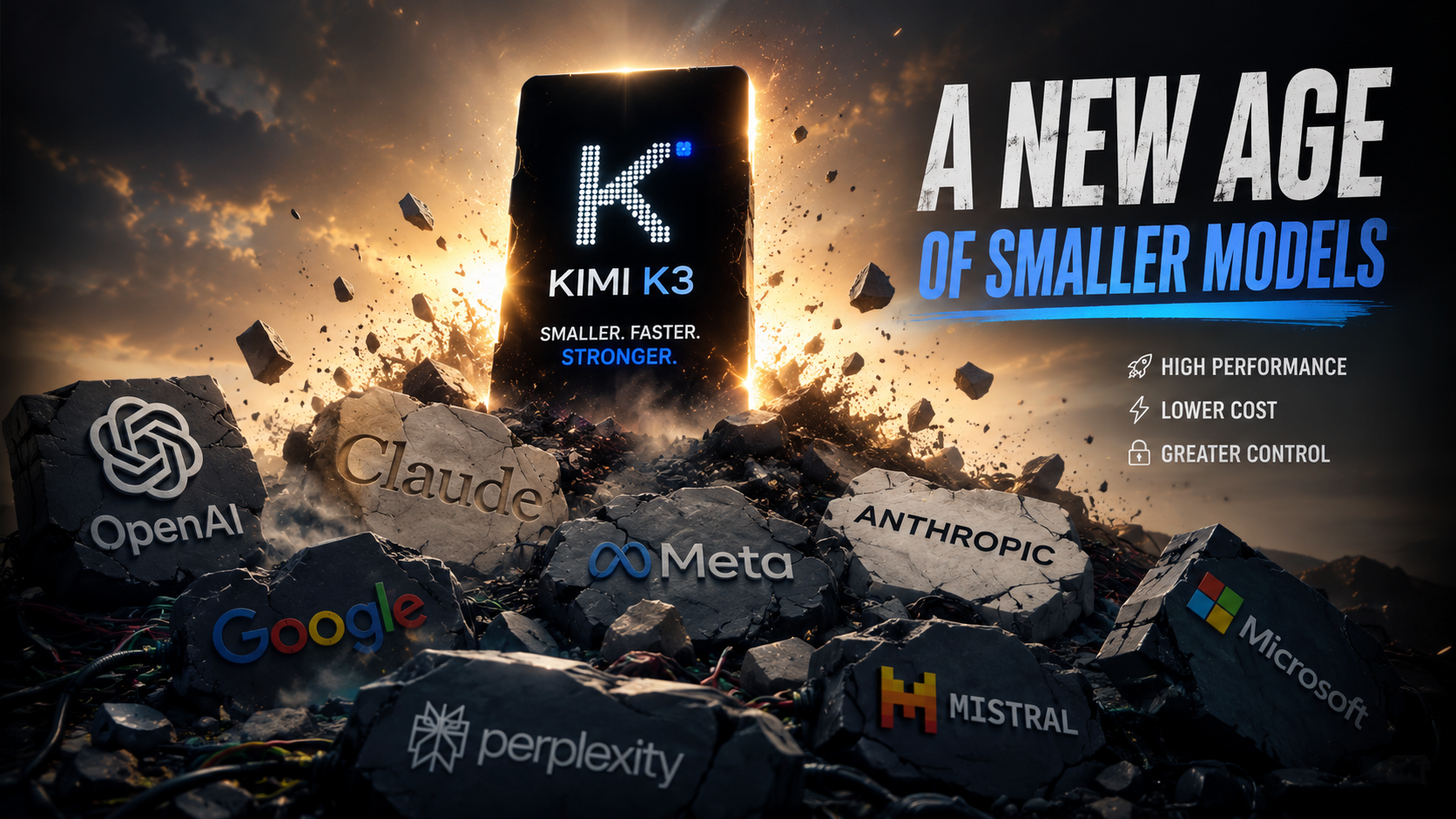
The latest generation of large language models, led by Moonshot AI's Kimi K3 and a wave of competing releases from the world's top labs, represents a genuine leap in what AI can do inside a business. Choosing the right model for your stack is no longer a purely technical decision. It is a strategic one, and the businesses that get it right will move faster, cut costs, and build software that stays relevant longer.
TL;DR
- Kimi K3 is a 2.8 trillion parameter open-weight model from Moonshot AI that now ranks number one in front-end code, content creation, brand and marketing, data analytics, and more.
- It jumped 17 places on benchmarks overnight, but this is not a surprise leap. Moonshot AI has held state-of-the-art among open-weight models for nine of the past twelve months.
- Frontier intelligence is now a perishable asset with a shelf life of weeks. The value is shifting to the interface and orchestration layer that can swap models rapidly.
- Open-weight models like Kimi K3 give every enterprise a path to fine-tune frontier-class AI inside their own walls without sharing proprietary data with a closed lab.
- A future-proof web development strategy treats model selection as modular, so you can swap or combine models as the landscape evolves.
- Mainstage Multimedia builds AI-accelerated web and software solutions designed to adapt, not to lock you into yesterday's stack.
What Is Kimi K3 and Why Is It Getting Attention?
Kimi K3 is a 2.8 trillion parameter multimodal open-weight model released by Moonshot AI, the Chinese lab that has quietly held state-of-the-art status among open-weight models for nine of the past twelve months. The latest release jumped 17 places on benchmarks overnight and now sits at number one in front-end code, content creation, brand and marketing, data analytics, consumer products, simulations, and reference-based design. That is not a narrow win in a niche category. That is dominance across the work most businesses actually care about.
The architecture is not exotic. Kimi K3 is still a transformer, using well-understood innovations like mixture of experts and linearized attention. What is remarkable is the efficiency story behind it. Due in part to US chip export controls on China, Moonshot AI had to get more out of less, and they did. Kimi K3 was trained on older Huawei chips, not cutting-edge Nvidia silicon, using advances in quantization, data curation, and kernel optimization. The model even designed its own chips and wrote its own kernels during training, a functional early signal of recursive self-improvement that the AI research community is watching closely.
As commentators like Peter Diamandis have noted on the Moonshot podcast, this raises a pointed question for US frontier labs: what exactly is all that capital buying? The cost to train a GPT-2 class model has dropped roughly 99 percent, and Kimi K3 is evidence that those same efficiency principles now apply at frontier scale.
What makes K3 practically interesting for businesses is its strength across the full content and code stack. It can plan multi-step tasks, call external APIs, write and execute code, and self-correct in a loop. That profile fits squarely into the kinds of workflows companies are now trying to automate: internal search, data pipelines, customer-facing agents, and developer productivity tools.
For a sharp analysis of what the Kimi K3 release signals about the broader model landscape, the Moonshot podcast breakdown on YouTube is worth your time. The conversation covers the efficiency story, the geopolitical backdrop, and what the open-weight movement means for enterprise AI strategy in practical terms.
The Closed Model Landscape: OpenAI, Anthropic, and Google
The three dominant closed-model providers each have a distinct identity worth understanding before you build around any of them.
- OpenAI (GPT-4o, o3, o3-mini): The broadest ecosystem, the most third-party integrations, and the most mature enterprise tier. OpenAI's reasoning models (the o-series) are strong at multi-step logic and code review. The tradeoff is cost at scale and the fact that your data flows through their infrastructure.
- Anthropic (Claude 3.5 and Claude 4 series): Claude models are consistently strong at following nuanced instructions, writing long-form structured content, and handling sensitive document review. Anthropic's constitutional AI approach gives enterprise buyers more confidence in guardrails. Claude also has a generous context window, which matters if you are processing large documents or codebases.
- Google (Gemini 2.5 Pro and Flash): Google's Gemini 2.5 Pro has posted top scores on several reasoning and coding benchmarks. Its native multimodal capability, meaning it reads images, audio, and video natively alongside text, makes it useful for businesses dealing with mixed media. Flash variants are optimized for speed and cost, making them strong candidates for high-volume inference tasks.
Open-Weights Models: Kimi K3, Llama, Mistral, and Friends
Open-weight models have closed the quality gap with closed models faster than most people expected. Alongside Kimi K3, the field includes Meta's Llama 4 series, Mistral's models, DeepSeek's releases, Mira Murati's Inkling, and several fine-tuned community variants. The business case for open-weight models comes down to a few real advantages.
- Data privacy: You run the model on your own infrastructure or a private cloud. Your proprietary data never leaves your environment.
- Cost predictability: You pay for compute, not per-token API fees. At high volumes, this can change the economics of a product significantly.
- Customization: You can fine-tune on your own data, adjust system prompts permanently, and build tightly integrated pipelines without API rate limits.
- Vendor independence: You are not one API deprecation notice away from a broken product.
The panel on the Moonshot podcast compared this moment to the release of Stable Diffusion, which triggered 200 million downloads and an ecosystem that accelerated generative media despite initially being seen as dangerous. Xi Jinping's speech at the World AI Conference in Shanghai explicitly backs open source AI as a public good, and Chinese model approval times have dropped from 60 days to roughly one week. The open-weight movement is not slowing down.
The tradeoffs are real too. Running and maintaining your own model infrastructure requires engineering investment. Safety and alignment are your responsibility. And the support ecosystem is thinner than what you get from an enterprise contract with OpenAI or Anthropic.
Closed vs. Open: A Practical Comparison for Business Decision-Makers
Rather than declaring a winner, the honest answer is that most mature AI strategies will use both. Here is a practical framework for thinking about it.
- Use a closed model when: you need the fastest path to production, your volume is moderate, you need enterprise SLAs and support, or your use case requires cutting-edge multimodal capability that open models have not yet matched.
- Use an open-weight model when: your data is sensitive or regulated, you are building at a scale where per-token costs become material, you want to fine-tune for a specific domain, or you need to run inference on-premises or in a private cloud.
- Use both when: you are building a layered product where a fast, cheap model handles routing and triage, and a more capable model handles complex reasoning. This is increasingly the pattern in well-architected AI products.
Analyst Gavin Baker has argued publicly that every company except the closed foundation labs is a net beneficiary of Kimi K3, and that silicon demand goes up, not down, as a result. The intelligence is commoditizing. The value is moving to whoever can orchestrate it best.
Frontier Intelligence Is Now a Perishable Asset
This is the strategic insight that changes how you should build. A model that is state of the art today may not be in six weeks. Kimi K3 proved that by jumping 17 benchmark places overnight. The shelf life of frontier intelligence is now measured in weeks, not years.
That means the competitive advantage no longer lives in which model you picked. It lives in the interface and orchestration layer you built around it. The businesses that win are the ones that can swap models rapidly, route tasks to the right model at the right cost, and evaluate performance continuously. As the Moonshot podcast framed it: intelligence, like information, wants to be free, and any attempt to constrain it historically fails and accelerates the competition it seeks to prevent.
Build for that reality, not for the model you are using today.
Upcoming Models Worth Watching
The pace of releases in 2025 is fast enough that any list is outdated quickly, but a few upcoming developments are worth building into your planning horizon.
- OpenAI GPT-5 and beyond: OpenAI has signaled a continued push toward unified reasoning and multimodal capability. Expect tighter integration between their o-series reasoning models and their general-purpose models.
- Anthropic Claude's next generation: Anthropic continues to invest in extended context and improved instruction-following, with enterprise document workflows squarely in its sights.
- Google Gemini Ultra updates: Google's advantage is native integration with its cloud and productivity suite, which makes it a natural fit for businesses already running on Google Workspace and GCP.
- Further Moonshot AI releases: Moonshot AI has held state-of-the-art nine of the past twelve months. Kimi K3 is not their ceiling. Watch this lab closely.
- Smaller, faster specialist models: The trend toward sub-10B parameter models that are fine-tuned for specific tasks is accelerating. Expect more purpose-built models for legal, medical, financial, and code-specific applications.
Why Your Codebase Architecture Matters More Than Your Model Choice
Here is the thing most vendors will not tell you: the model you pick today will probably not be the model you use in 18 months. The field moves too fast. What actually determines whether your business stays ahead is whether your codebase is built to swap and upgrade models without a full rebuild.
That means building around abstraction layers, not hard-coding to a single provider's SDK. It means using orchestration frameworks that let you route requests to different models based on task type, cost, or latency requirements. It means storing and managing your prompts as versioned assets, not buried in application logic. And it means logging and evaluating model outputs so you know when to upgrade.
This is not exotic engineering. It is just good architecture, applied to AI. But it requires someone on your side who understands both the AI layer and the application layer, and who is building for your long-term outcomes, not just shipping a demo.
How Mainstage Builds AI-Ready Web and Software Solutions
At Mainstage Multimedia, our AI-accelerated web design and development work starts with a strategy conversation, not a tool selection conversation. We ask what you are trying to accomplish, what your data looks like, what your team can actually maintain, and what your growth trajectory demands. Then we build around the answers.
We use AI to move faster at every stage, from initial architecture planning to code generation to QA. But every decision is made by a human who understands your business context. We build abstraction layers so your AI integrations are modular. We document everything and hand you a codebase you own outright, with no platform lock-in and no ongoing dependency on us to keep the lights on.
When a better model drops, and one will, your product is ready for it. That is what future-proofing actually looks like in practice.
Practical Steps to Take Right Now
- Audit your current AI integrations. Are you hard-coded to a single provider? Do you have logging and evaluation in place? Do you know what each integration costs at your current and projected volume?
- Define your use cases clearly. The model that is best for customer-facing chat is probably not the best for internal code review or document summarization. Separate your use cases before you standardize on a model.
- Build or demand an abstraction layer. Whether you are working with an internal team or an external partner, make model-swapping a design requirement from day one.
- Stay close to the benchmark releases. MMLU, HumanEval, GPQA, and SWE-bench are imperfect but useful proxies. When a new model drops a strong benchmark score in your use case area, that is a signal to evaluate it.
- Plan your evaluation cadence. Set a quarterly or semi-annual review to assess whether your current model selection still makes sense. Treat it like a software dependency review.
The businesses that win with AI are not the ones that bet everything on one model. They are the ones that build adaptable systems and stay close enough to the landscape to move when the moment is right. If your current web and software stack is not set up to do that, now is a good time to fix it.
Ready to build a codebase that keeps up? Explore our AI web design and development work or contact our team to talk through what future-proofing looks like for your specific situation.