



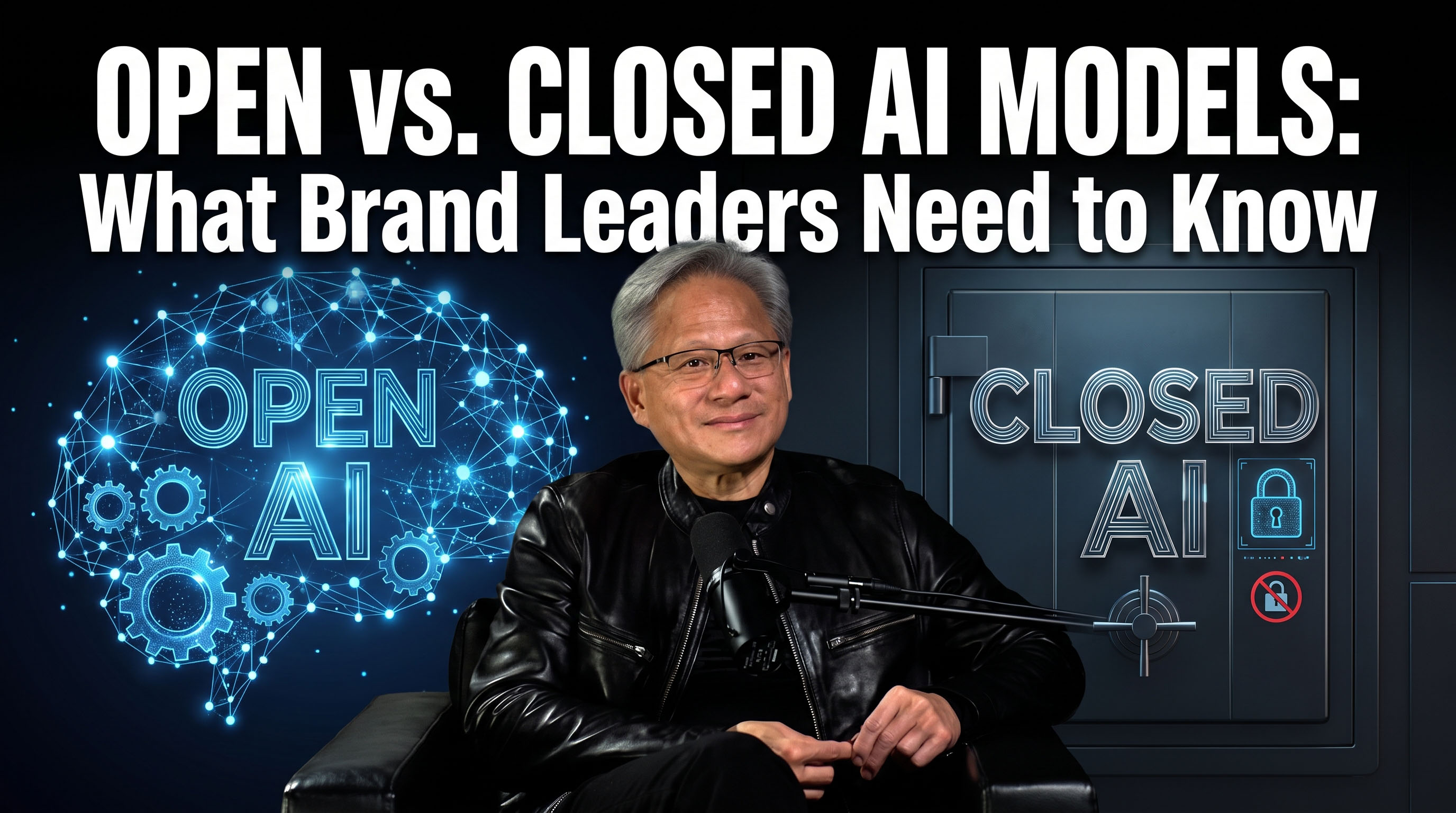
The most important AI decision a marketing leader will make is not which tool looks most impressive in a demo. It is whether the AI touching your brand assets, your customer data, and your campaign strategy is open or closed, and what that actually means for your business. Jensen Huang laid out the core distinction clearly in a recent conversation with Mike Allen on Axios Behind the Curtain, and it is worth translating that thinking into something a brand or marketing leader can actually act on.
TL;DR: Open AI models are transparent and customizable but require technical infrastructure to use safely. Closed models are powerful and accessible but what you feed them may train the system you are feeding. Knowing the difference helps you decide what to trust with your brand IP, your campaign data, and your production pipeline. At Mainstage, we use AI to move faster while keeping every client's content inside a controlled environment they fully own.
The Distinction Huang Makes and Why It Matters
As Jensen Huang discussed on Behind the Curtain, open models are published openly so developers and organizations can inspect, customize, and run them on their own infrastructure. Closed models are proprietary systems accessed through an interface or API, where the model itself remains inside someone else's environment.
Huang frames this not as open being good and closed being bad, but as two fundamentally different value propositions. Open models give you control and transparency. Closed models give you power and convenience. The catch is that convenience can come with a cost most marketing teams have not fully thought through.
That cost is data. When you use a closed consumer AI tool to generate campaign copy, remix brand assets, or analyze customer research, you are often feeding proprietary information into a system you do not control, cannot audit, and may be contributing to in ways that benefit others.
What "Open" Actually Means for a Marketing Team
An open model, at its simplest, means the model weights are publicly available. Organizations with the right technical team can run that model on their own servers, customize it on their own data, and keep every input and output inside their own four walls.
For a brand or marketing leader, this translates to a few concrete things:
- Your creative briefs, brand voice guidelines, customer personas, and campaign data never leave your environment.
- You can fine-tune the model on your specific brand language, tone, and product knowledge so outputs actually sound like you.
- There is no third party sitting between your IP and the output.
The trade-off is real. Running open models well requires infrastructure, expertise, and ongoing maintenance. Most marketing departments do not have that in-house, which is why the decision of who builds and manages your AI-accelerated production pipeline matters as much as which model you pick.
What "Closed" Actually Means for a Marketing Team
Closed models, like the ones powering the most widely used consumer AI tools, are often more capable out of the box and far easier to access. You log in, you prompt, you get an output. That frictionlessness is genuinely valuable, and there are legitimate use cases where closed tools are fine.
The risk zone is when you start feeding them sensitive inputs: unreleased product details, proprietary research, customer data, internal strategy documents, or detailed brand system files. At that point, the convenience of a closed tool starts working against you, because you have no visibility into how that data is stored, processed, or potentially used.
There is also a brand consistency problem. Closed general-purpose models are trained to serve everyone. They do not know your brand, your audience, or your specific voice unless you tell them every single time, and even then the outputs drift.
The Questions Marketing Leaders Should Be Asking Right Now
You do not need to become an AI researcher to make smart decisions here. You need to ask the right questions of every vendor, agency, or internal team using AI on your behalf.
- Where does our data go? If the answer is vague, that is a signal. Any production partner using AI on your brand assets should be able to tell you exactly where inputs are processed and whether they leave a controlled environment.
- Does using this tool train the model? Many free and freemium AI tools use your inputs to improve the underlying model. That means your creative work, your strategy, your voice may be contributing to a system that serves your competitors too.
- Who owns the output? IP ownership in AI-assisted work is still evolving, but your production partner should be clear that the finished assets belong to you, not to them and not to a platform.
- Is the AI accelerating human craft or replacing it? The best AI-assisted production uses the technology to compress timelines and remove friction while keeping human judgment at every creative and strategic decision point. AI setting the brand direction without a skilled producer or director in the loop is how you end up with generic, off-brand content at scale.
How Mainstage Uses AI in Production
At Mainstage, we use AI across our production pipeline: for video work, web builds, podcast post-production, and design. The principle we apply is straightforward. AI accelerates, humans direct, and clients own everything.
When we use AI tools on a client project, we are deliberate about which tools touch which assets. Client brand files, scripts, strategies, and unpublished content stay inside controlled environments. We use open or self-hosted models where data sensitivity demands it, and we use closed tools only for tasks where the input carries no proprietary risk.
The result is that clients get the speed and cost advantages of AI without the exposure that comes from feeding sensitive material into a general-purpose consumer product. And because we are a single team from concept to delivery, there is no gap between the people making AI decisions and the people responsible for the final work. The same producer overseeing your brand film strategy is the one deciding what AI tools touch your assets and how.
For our AI-accelerated web design and development work, this matters especially. Analytics dashboards and site infrastructure we build for clients are owned outright by the client, not licensed through a platform. That philosophy extends to how we handle AI in production: you leave with work that is yours, built on decisions you can trace.
Practical Guidance: Where to Draw the Line
Here is a simple working framework for deciding what AI can and cannot touch in your production process.
- Low risk for closed tools: Generating rough-draft copy from a public brief, brainstorming campaign names against publicly available information, transcribing recorded interviews, resizing finished and already-published assets.
- High risk for closed tools: Anything involving unreleased product information, proprietary customer research, internal strategy, brand system files, or personally identifiable information about your customers or team.
- Always worth asking: What is the terms-of-service position on training data? What is the data retention policy? What is the process if something goes wrong?
These are not hypothetical concerns. They are the kinds of questions a good production partner should already have answered before you ask them.
The Bottom Line for Brand and Marketing Leaders
Jensen Huang's framing on Behind the Curtain cuts through a lot of the noise. Open and closed models are tools with different properties, not moral categories. The job of a smart leader is to match the tool to the task and to make sure whoever is using AI on your behalf has a clear and defensible answer to where your data goes and who owns what comes out.
AI is not going away from production pipelines, and it should not. Used well, it compresses timelines, reduces revision cycles, and lets skilled producers focus on the work that actually moves a brand forward. Used carelessly, it trades short-term convenience for long-term exposure on IP, data, and brand consistency.
If you want to talk through how we structure AI use in our production work, or if you are building out a content, web, or video pipeline and want a partner who can answer these questions clearly, we would be glad to have that conversation. Explore our AI-accelerated production services or reach out to book a call with David and the Mainstage team.