


Your audience watches prestige television every night. By the time they open your corporate training module or brand video on Monday morning, they have spent the weekend with cinematic color grades, layered sound design, and writing that respects their intelligence. If your video feels like a recorded Zoom call, they will feel the gap immediately, even if they cannot name it.
TL;DR
- Streaming has trained everyday viewers to expect high production values and strong storytelling from everything they watch, including corporate content.
- L&D and brand teams that ignore this shift see lower course completion, weaker brand recall, and disengaged employees.
- The fix is not a bigger camera. It is a producer-led approach that starts with story and strategy, then wraps both in genuine craft.
- Mainstage Multimedia builds corporate video end to end, from concept through delivery, so the finished product feels like a production, not a meeting recording.
How Audiences Got So Sophisticated So Fast
In a wide-ranging conversation on The Joe Rogan Experience, Joe Rogan, Matt Damon, and Ben Affleck traced the arc of how Americans consume stories. They talked about the shift from weekly theater outings as a genuine cultural event to the on-demand era, where a full season of something that looks and feels like a theatrical film lands in your living room on a Friday night. The point that lands hardest for anyone in corporate media is this: that shift did not just change what people watch. It changed what people expect from every screen in front of them.
Damon and Affleck, who have spent decades inside the economics of storytelling, spoke to how the sheer volume of high-quality content has reset the baseline. Audiences are not impressed by production value anymore. They simply notice when it is missing.
That is the environment your corporate video lives in now.
What This Means for L&D and Brand Teams
Learning and development managers often hear the same complaint after rolling out a new training program: completion rates are low and retention is lower. Blame is placed on the subject matter or the LMS. But often the real culprit is simpler. The video does not hold attention because it does not feel worth watching.
Brand leaders face an adjacent problem. A corporate sizzle reel or testimonial video that looks like it was shot in an afternoon does not just fail to impress. It actively signals that the brand does not take itself seriously. In a world where a viewer's reference point is the opening sequence of a prestige drama, that is a hard hole to climb out of.
The viewer does not lower their standards when they clock in. They bring the same eyes they used on Saturday night.
Production Value Is Not About Budget. It Is About Craft and Intentionality.
Here is the good news. The gap between a forgettable corporate video and one that actually holds attention is not primarily a budget gap. It is a craft and intention gap.
Prestige content earns its feel through a few specific choices that are fully available to corporate production when a real producer is running the project.
- Story structure before scripts. Every memorable piece of video content, from a ten-season drama to a three-minute brand film, has a clear narrative arc. Someone wanted something, something stood in the way, something changed. Corporate video that skips this step never connects, no matter how good the camera is.
- Sound design and music. Viewers feel audio before they consciously hear it. A thin or absent sound bed makes any video feel cheap. Intentional music and clean, mixed audio communicate quality instantly.
- Lighting and location as storytelling tools. A talking head in a beige conference room tells the viewer this was an afterthought. A thoughtfully lit subject in a purposeful environment says the opposite.
- Editing that respects attention. Streaming audiences have absorbed tens of thousands of hours of professional editing. They feel bad cuts. Pacing matters more than length.
- A clear point of view. Great content has a perspective. It takes a position. Corporate video that tries to say everything to everyone ends up saying nothing to anybody.
The Real Problem With Most Corporate Video
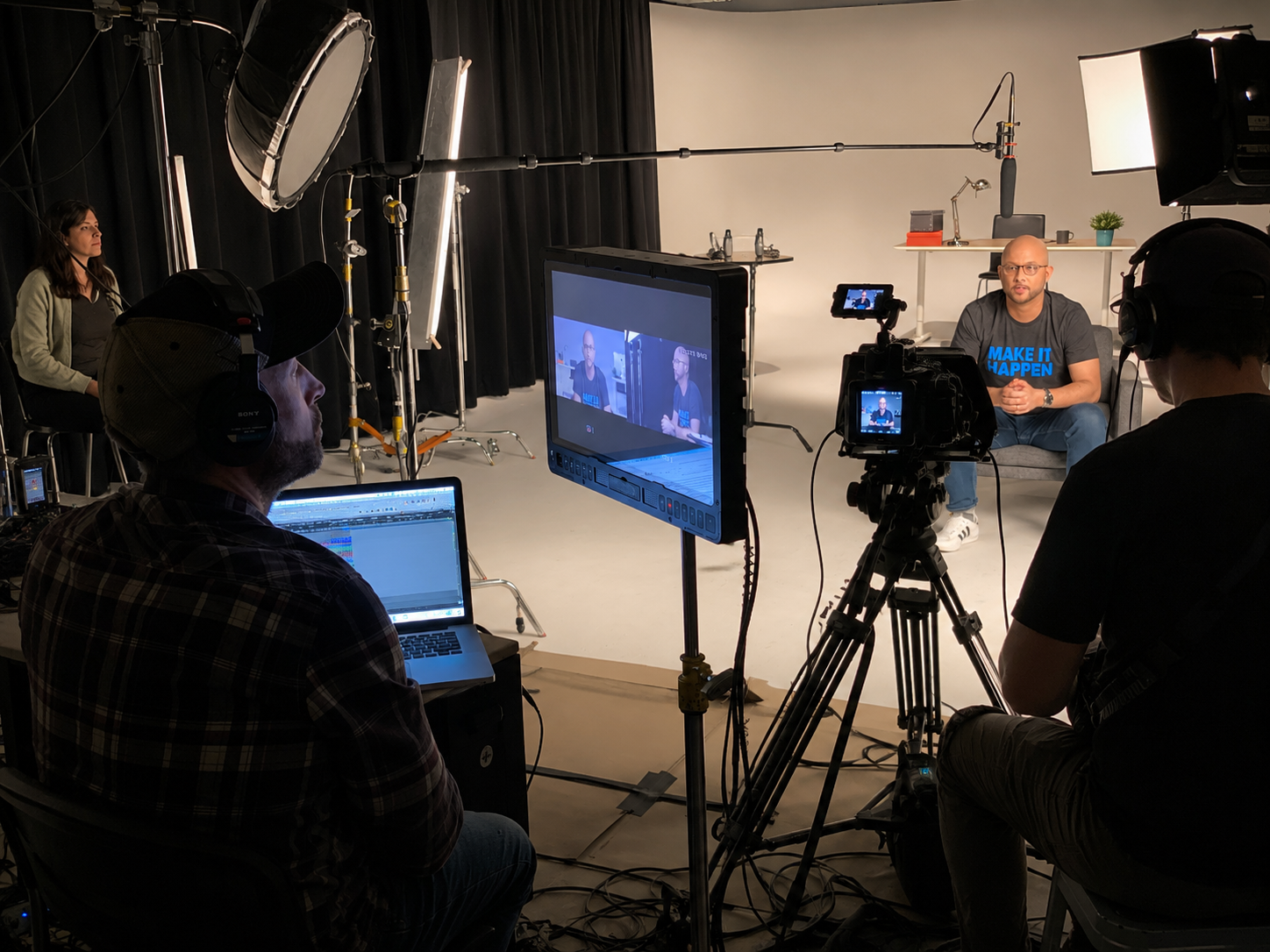
Most corporate video fails not because the organization lacks resources, but because it is treated as a logistics problem rather than a production problem. Someone books a camera operator, a conference room, and a half day of executive time. The result is technically a video. It is almost never content that changes behavior or moves a brand forward.
The streaming era has made this approach obsolete. When Matt Damon and Ben Affleck discussed on the JRE how the collapse of the mid-budget theatrical film forced storytellers to think more carefully about what deserves a screen, the underlying truth applies to corporate content too. Not everything needs to be a blockbuster. But everything that asks for someone's attention needs to have earned it.
The difference between a production and a recording is a producer. Someone who starts with the outcome, builds a strategy around it, and then deploys craft and crew in service of that strategy.
What a Producer-Led Approach Actually Changes
At Mainstage, we do not show up with a camera and wait for direction. We start every engagement with a strategy conversation. Who is this for? What do we need them to feel, know, or do by the end? What is the one thing this piece has to communicate clearly?
Those answers shape everything that follows: the script, the visual language, the pacing, the music, the final delivery format. By the time a frame is shot, the whole piece is already built in the plan. That is what a production looks like. And that is what your audience, trained by years of streaming, is now quietly measuring you against.
Whether it is a corporate training series that needs to drive real completion and behavior change, or a brand film or commercial that needs to hold its own alongside the content your customers watch every evening, the approach is the same. Strategy first, craft second, logistics last.
The Baseline Has Moved. The Window to Catch Up Is Still Open.
The organizations that will win the next decade of internal communication and brand storytelling are the ones that treat video as a production discipline, not a box to check. The streaming era did not raise the bar just for Hollywood. It raised the bar for every screen your audience looks at.
The good news is that most corporate content is still stuck in 2012. That means the organizations willing to close the gap right now will stand out dramatically, without needing a streaming budget to do it.
If you are ready to find out what your corporate or brand video could look like when it is built like a production from the start, explore what Mainstage brings to the table or reach out to book a strategy call with David. We will start with your outcome, not a camera package.