



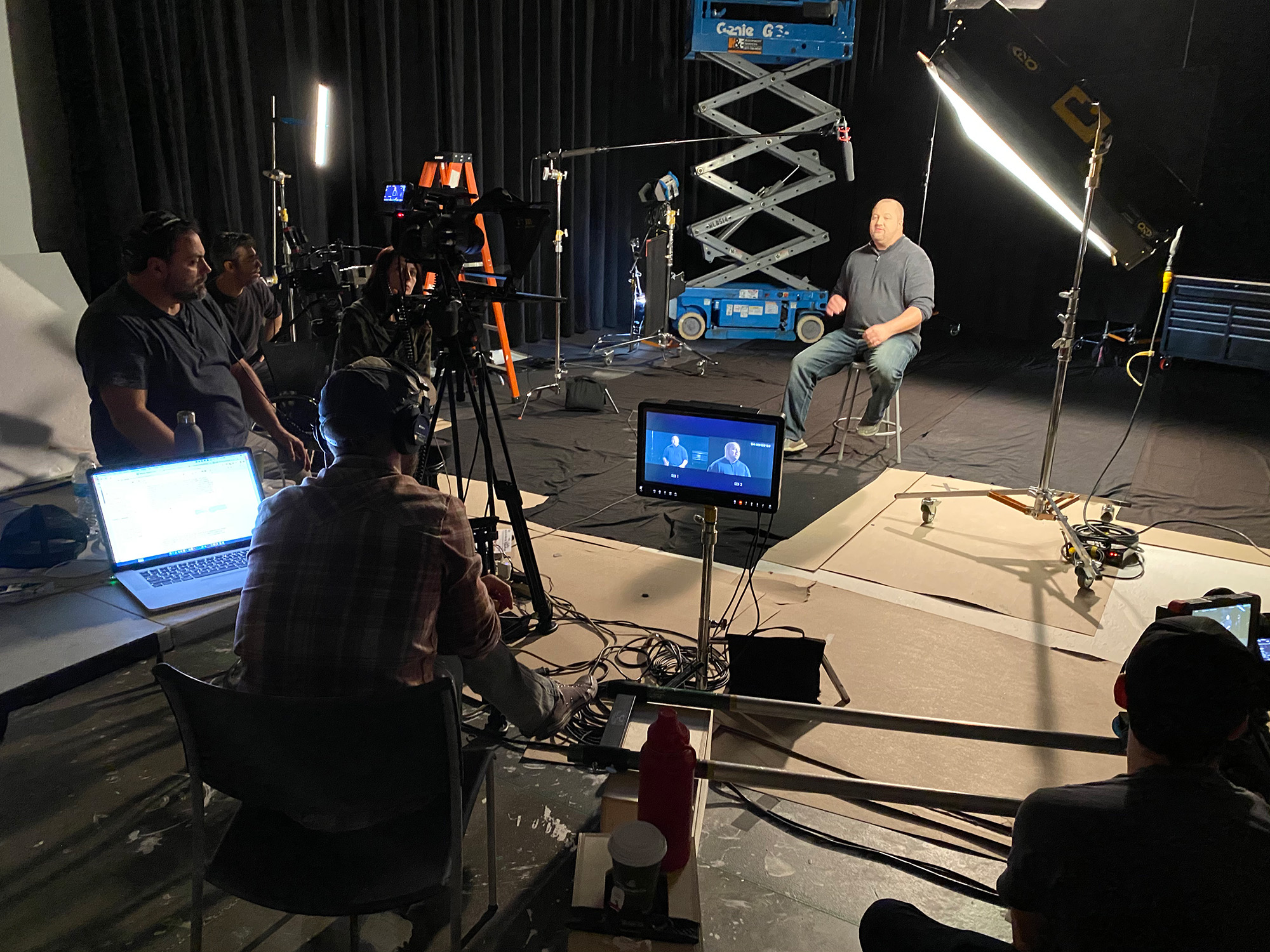
The most resilient production partner you can have right now is one integrated team that owns the entire process from strategy to delivery. When the tools change, and they will change fast, a turnkey studio absorbs that disruption internally so your campaign, course, or content program keeps moving. A roster of specialized freelancers, each dependent on a single platform, cannot do that.
When a Week Feels Like a Decade
In a recent episode of Moonshots with Peter H. Diamandis, Peter H. Diamandis, Salim Ismail, Dave Blundin, and Alexander Wissner-Gross described the current pace of AI development as a decade compressed into seven days. That framing is not hyperbole. It is a precise description of the operational reality facing every team that produces content, training material, or branded media right now.
New models appear. Old ones go offline. Pricing structures shift. Regulations catch up. A workflow that was stable last quarter can become unreliable, expensive, or legally complicated before your next production cycle begins.
If your production infrastructure is a collection of independent specialists, each one optimized for a single tool or platform, that fragility is your problem to manage. You become the integrator. You absorb the disruption. And your project pays the price in delays, rework, and budget overruns.
The Hidden Cost of Piecemeal Vendor Relationships
Most marketing and L&D buyers assemble production teams the same way they always have: a freelance video editor here, a motion graphics person there, a separate studio for podcast audio, a web developer contracted by the hour. Each vendor is skilled. Each one delivers their piece. But no one owns the whole outcome.
That model has a structural weakness that AI acceleration has made impossible to ignore.
- Tool dependency. A freelance editor whose entire workflow runs on one AI platform is exposed the moment that platform changes its pricing, deprecates a feature, or goes dark. You inherit that risk.
- No one holds the strategy. When a project pivots, individual vendors optimize for their own deliverable. No one recalibrates the whole.
- Handoff friction multiplies. Every time a file, brief, or piece of feedback crosses from one vendor to another, you lose time, context, and consistency. In a fast-moving environment, those losses compound quickly.
- Compliance gaps appear at the seams. As AI-related regulations evolve around disclosure, training data, synthetic voice, and likeness rights, the gaps between vendors are exactly where liability hides.
None of these problems are new. But the pace described by Diamandis, Ismail, Blundin, and Wissner-Gross on Moonshots makes them urgent in a way they have never been before.
What a Turnkey Partner Actually Absorbs
A genuinely integrated production studio does not just bundle services. It holds the strategy, owns the workflow, and takes responsibility for the finished outcome. That distinction matters practically.
When a tool changes, the studio retools internally. The client does not get an email explaining why the timeline slipped because a plugin broke. When a regulation shifts around AI-generated content, the studio updates its process and its compliance posture, not the client's legal team. When a creative direction needs to pivot mid-production, one producer makes that call and communicates it across every discipline simultaneously.
That is what resilience looks like in a production context. It is not about using the best tools. It is about owning the outcome regardless of what the tools do.
Why This Matters Most for Marketing and L&D Buyers
Marketing leaders and learning and development managers are under the same acceleration pressure as everyone else, but they carry an additional burden: their deliverables are visible. A brand film that misses the launch window costs real pipeline. An e-learning course that stalls in production costs real training time and real compliance risk.
Piecemeal vendor rosters shift that management burden onto the buyer. A turnkey partner shifts it back where it belongs, onto the production team.
For marketing buyers, that means a brand film, a product video, or a content series that arrives on time, on brand, and ready to publish, without the buyer acting as a project manager for four separate contractors.
For L&D managers, it means a corporate training video or e-learning module that is built around learning outcomes from the start, not assembled from disconnected parts and then retrofitted with instructional logic at the end.
In both cases, what the buyer actually buys is certainty. That is the product a turnkey partner delivers.
AI as an Internal Tool, Not an External Risk
The instinct among many buyers right now is to treat AI as something to be cautious about in vendor relationships. That instinct is reasonable. But the right response is not to avoid AI-forward studios. It is to find one where AI is a controlled internal capability, not a dependency on a single third-party platform.
At Mainstage, AI accelerates the work we already know how to do. It speeds up research, scripting, editing passes, and web development cycles. But a human producer holds every creative decision. A human director shapes every frame. And the client owns every deliverable outright, with no platform subscription standing between them and their own content.
That is the right relationship with AI in a production context: a tool that moves the team faster, not a vendor that creates new single points of failure.
The Compounding Value of One Team Over Time
There is a less obvious advantage to the turnkey model that becomes clearer the longer a client relationship runs. An integrated team builds institutional knowledge about your brand, your audience, your approval process, and your strategic goals. That knowledge compounds.
A freelance roster resets that knowledge every time a contractor rotates out or a new project kicks off. You re-brief. You re-align. You re-explain the nuances that took months to establish. In a market moving at the pace Diamandis and his co-authors on Moonshots described, that reset cost is not sustainable.
One team that stays through the work, from the first strategy conversation to the final delivered asset, accumulates context that makes every subsequent project faster, sharper, and more aligned with what you actually need.
What to Look for in a Turnkey Partner
Not every studio that calls itself full-service actually operates as a single integrated team. Here are the questions worth asking before you commit.
- Who holds strategy? There should be a named producer or director who is accountable for the outcome, not just the deliverable.
- Who owns the workflow? The answer should be the studio, not a patchwork of subcontractors who have never spoken to each other.
- How do you handle tool changes mid-project? A real integrated team has an answer. A vendor aggregator will pause the project and wait for you to decide.
- Who owns the finished work? You should own it outright, with no licensing strings tied to a platform the studio uses.
- Can you show the full process, not just the portfolio? A turnkey partner can walk you through every stage of production, not just show you the final cut.
The Mainstage Approach
Mainstage Multimedia is a Las Vegas-based, nationally working production studio that plans, produces, and delivers finished work end to end. Our team handles brand films, commercials, and video production, corporate training and e-learning video, podcast production, and AI-accelerated web design and development, all under one roof, with one producer accountable from the first conversation to the final delivery.
We use AI to move faster. We use human judgment to move right. And we deliver work that clients own completely, with no platform dependency hanging over the asset they paid for.
In a market where the tools change faster than freelance rosters can adapt, that is the production relationship worth building.
If the pace of change in your production environment is starting to feel unsustainable, let us talk about what a turnkey approach looks like for your next project. One conversation is usually enough to show whether it fits.