


AI will not replace your video and content team. It will change how that team works, and the studios that understand the difference will deliver better work faster. The ones that miss it will either over-automate and lose the craft, or under-adopt and lose the speed. Neither outcome serves your brand or your learners.
TL;DR
- The most extreme AI job-loss predictions are not supported by how technology historically enters industries.
- AI diffuses into production workflows, it does not replace the judgment, strategy, and storytelling that make content perform.
- A producer-led team uses AI to compress timelines and cut repetitive work, freeing humans to focus on the decisions that actually move the needle.
- For decision-makers evaluating AI-assisted production: ask what AI is doing, not just whether it is being used.
The Fear Is Real, and It Deserves a Direct Answer
If you lead a marketing team, an L&D department, or a brand, you have almost certainly had a version of this conversation: someone at the table asks whether AI means you can cut the production budget, reduce headcount, or skip hiring a studio altogether. It is a fair question, and it deserves a fair answer.
In a conversation with Mike Allen on Axios Behind the Curtain, Jensen Huang addressed the sweeping predictions about AI eliminating jobs head-on, calling the most extreme forecasts complete nonsense. His argument is not that AI is harmless or slow-moving. It is that technology does not vaporize industries. It diffuses into them, reshaping how work gets done rather than eliminating the need for the work itself.
That framing matters, because it is closer to what we actually see happening inside production studios right now.
What Diffusion Actually Looks Like on a Production Team
When a new tool enters a craft-based discipline, it tends to compress the low-judgment tasks and raise the stakes on the high-judgment ones. That is exactly what AI is doing in video and content production.
Consider what a producer spends time on before a single camera rolls: briefing documents, script drafts, shot list organization, research, scheduling, asset gathering, caption generation, rough cut assembly notes. These are necessary. They are also not where the value lives. The value lives in knowing which story angle will land with a specific audience, which interview question will open someone up, which visual metaphor will make a compliance training module feel like something an employee actually wants to finish.
AI can accelerate the first list. It cannot do the second list. A producer-led team uses both.
The Mistake Most Brands Make When They Hear "AI-Assisted Production"
The mistake is treating AI as a cost-reduction tool first. That framing leads to cutting the wrong things. You end up with faster output that underperforms because the strategic layer, the casting instinct, the director's eye, the writer who knows your brand voice, got stripped out along with the manual tasks.
The better frame, the one that actually shows up in finished work that converts leads or gets training courses completed, is to treat AI as a production accelerant. You are not removing people. You are removing friction so the people you have can spend more time on the decisions that require human judgment.
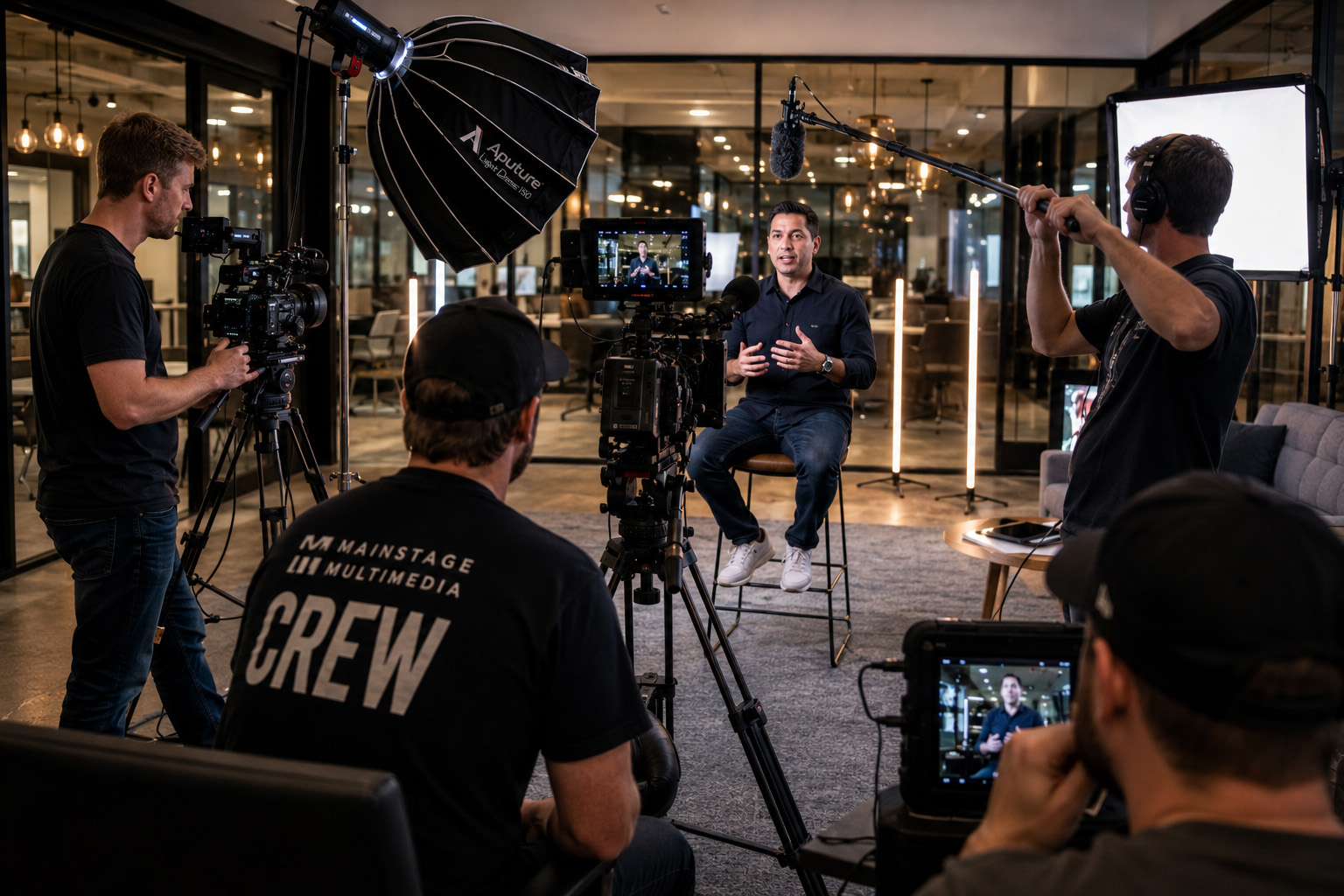
At Mainstage, that is exactly how we integrate AI into our workflows. Script research moves faster. Rough selects from an interview session get organized more quickly. Subtitle and caption passes that used to eat hours are handled in minutes. That compression shows up as shorter timelines and sharper focus, not fewer humans in the room.
What a Producer-Led AI Workflow Actually Protects
Not all human involvement in a production is equal. When we think about where AI cannot substitute for a person, a few things stand out clearly.
Strategy and outcomes. A brand film that looks beautiful but does not connect to a business goal is expensive decoration. A training video that covers the material but does not change behavior is a compliance checkbox. Defining the actual goal, and building the production backward from that goal, requires someone who asks uncomfortable questions before the cameras come out. No tool does that.
Direction and performance. Getting a real, credible performance from an executive on camera, or coaxing a subject matter expert to explain a complex process in plain language, is an interpersonal skill. It takes reading the room, building trust in real time, and knowing when to stop rolling and have a different conversation. That is a director's job, and it is irreplaceable.
Brand judgment. Knowing when a color grade feels slightly off-brand, when a music choice undercuts the message, when a cut is too fast for the emotional beat the scene needs. These are taste decisions. They are built from experience and context, not from a prompt.
Client trust. Decision-makers who hand over their brand, their training content, or their company story are not just buying deliverables. They are buying confidence that someone is accountable for the outcome. That relationship is human by definition.
The Question to Ask Any Production Partner
When you evaluate a studio or production team that says they use AI, the right question is not "how much AI?" The right question is: what is the AI doing, and what are the humans doing?
If the answer suggests AI is handling research, organization, and first-pass repetitive tasks while experienced producers and directors are driving strategy, story, and quality control, that is a healthy workflow. You get speed without sacrificing craft.
If the answer suggests AI is generating the script, AI is assembling the edit, and a human is mostly just pressing approve, you should look carefully at what you are actually getting. Faster and cheaper is not better if the work does not perform.
What This Means for Your Next Production
The brands and L&D teams that are winning right now are not the ones who either panic about AI or pretend it does not exist. They are the ones who found production partners who have figured out the right division of labor, where machines handle the mechanical and humans handle the meaningful.
That is a producer-led model. It starts with your goals, builds a strategy around them, uses every tool available to move efficiently, and never lets efficiency become an excuse for skipping the craft. Whether we are producing a brand film or commercial, a series of corporate training videos, or a full podcast operation, the through-line is the same: a human producer is accountable for the outcome, and AI is in the toolkit, not in the driver's seat.
If you are trying to figure out how to structure a smarter production engagement, one where you get faster timelines without trading away the quality your brand depends on, we would be glad to talk it through. Explore our video production work or reach out to book a conversation with David and the Mainstage team.